Ontario City Library, Ontario, California

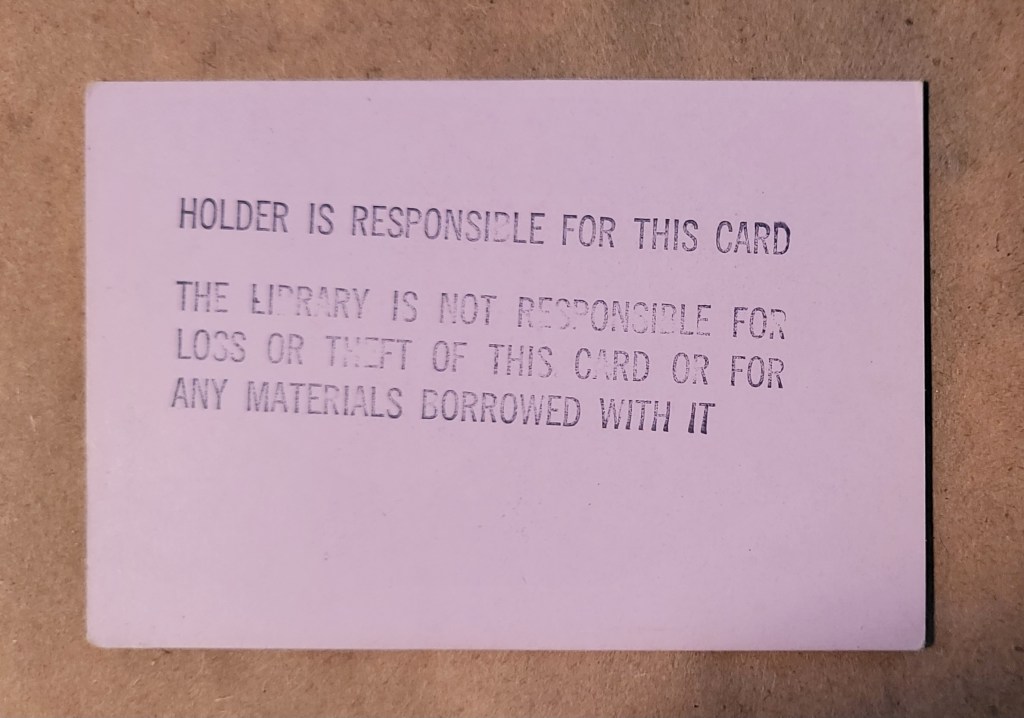
1961-1964 Ontario City Library Card for Chaffey High School Students
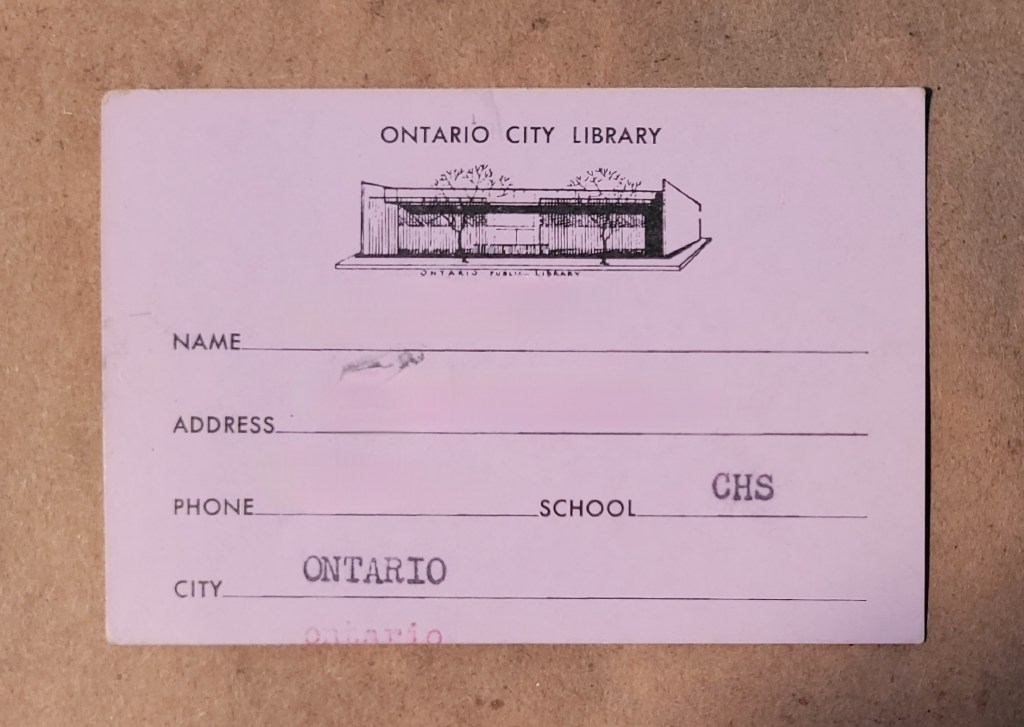
1961-1964 Library Card issued to Chaffey High School students for use at the Ontario City Library (front)
(living person information redacted)
1961-1964 Library Card issued to Chaffey High School students for use at the Ontario City Library (back)

Ontario, California – The Chaffey Brothers’ Vision
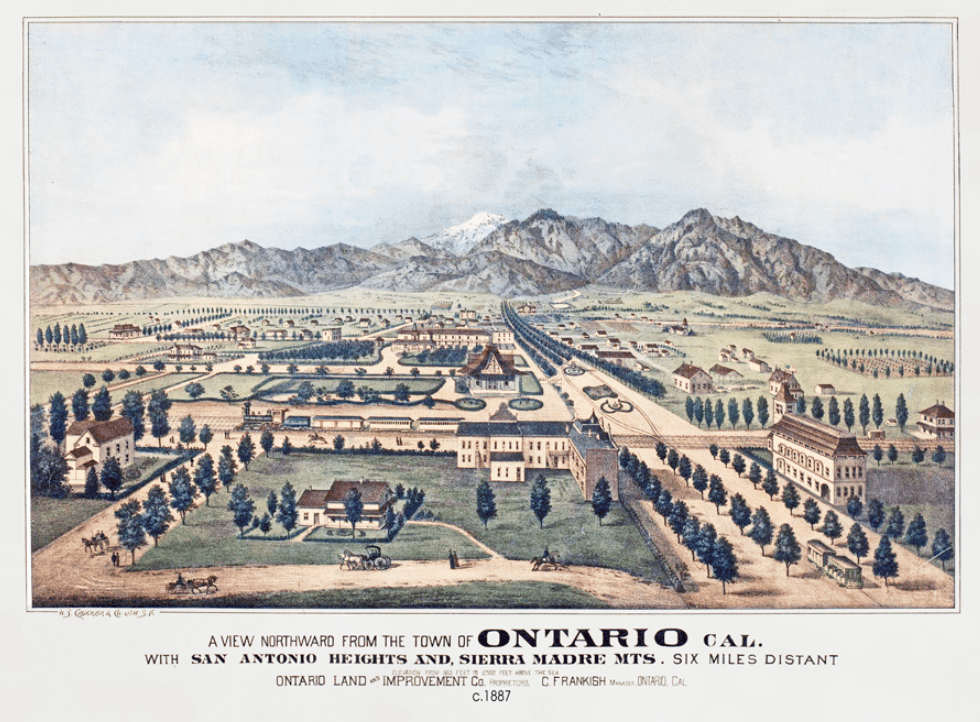
Ontario, California, circa 1887, published by H.S. Crocker Co.
Pre-1923 public domain publication. No known copyright restrictions.

In 1881, brothers William B. (1856-1926) and George Chaffey, Jr. (1848-1938), both engineers from Brockville, Ontario, Canada, began purchasing parcels of land in Southern California with the intention of creating “irrigation colonies” complete with water resources, water-powered cable cars, grand avenues illuminated with electric lights, and convenient access to the existing Southern Pacific Railway. Those land purchases became the Etiwanda, Upland, and Ontario Settlements. Due to the mild winter climate and easy access to water from the nearby mountains, citrus farmers were some of the first landowners in Ontario.

Advertisement announcing the town and settlement of Ontario. Ten-acre and 120-acre parcels were sold for $150-250 per acre.
Pomona Times-Courier, 23 Dec 1882, Sat ·Page 3

Ontario City Library

The Ontario City Library was established in 1885, according to Publication No. 3, “The Libraries of California in 1899”, which was published by the Library Association of California in April 1900. Although it was organized by the town of Ontario, the library earned its revenue through annual subscriptions of $1.00 and community fund-raising events, such as citrus fairs and concerts. Not until 1902 would the library become a free public library.

One of the earliest newspaper mentions of the “Ontario Public Library” was in 1886 when Richard Gird, a successful silver miner and local real estate investor from Tombstone, Arizona, donated fifty volumes to the “Ontario Public Library.”  

Los Angeles Herald, 04 Jun 1886, Fri · Page 5

In 1894, for the first time, the Trustees of the California State Library recognized and included the “Ontario Public Library” in the fiscal report for the Forty-Fourth and Forty-Fifth Fiscal Years (July 1, 1892 to June 30, 1894). It was noted that the library was “too recently organized to furnish statistics.”

One of the earliest locations of the library was at the southwest corner of A Street (now Holt’s Boulevard) and Euclid Avenue in a 2-story brick building known as the Ohio Block. The Ohio Block was built by Miss Eleanor Freeman (1848-1904) in 1888. Freeman, originally from Cincinnati, Ohio, was so charmed by the weather in Ontario that a temporary three-week stay resulted in the purchase of a twenty-acre tract of land. Freeman and her niece, Mary Ellen Agnew (1851-1914), served as the first librarians.
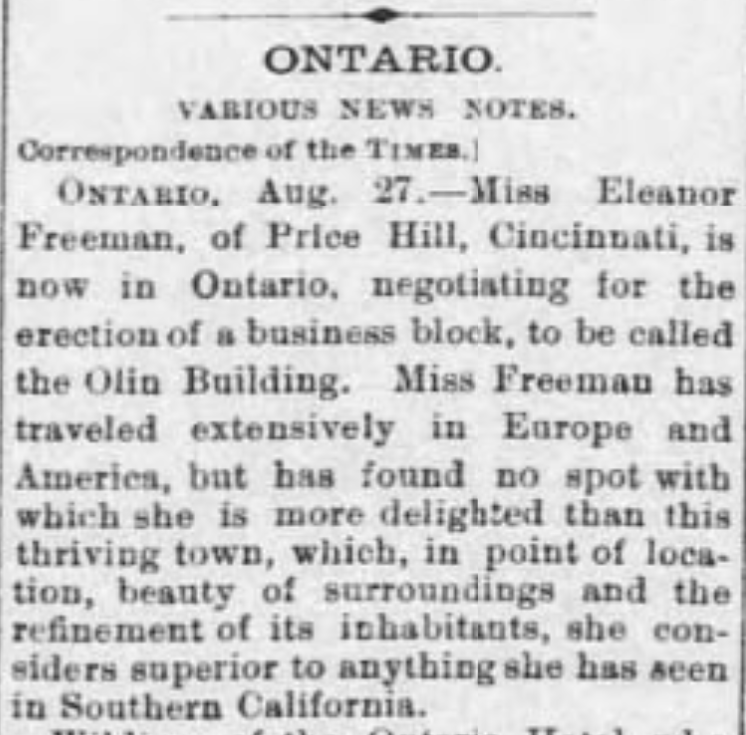
The Los Angeles Times, 29 Aug 1885, Sat ·Page 4
Built in 1888, the Ohio Block was razed in 1931. Photo Source: City of Ontario Facebook Page/Robert E. Ellingwood Model Colony History Room. No known Copyright restrictions.
Euclid Avenue Postcard, circa 1905. Originally published by Brück & Sohn Kunstverlag (Germany).
Creative Commons CC0 1.0 Universal Public Domain Dedication.
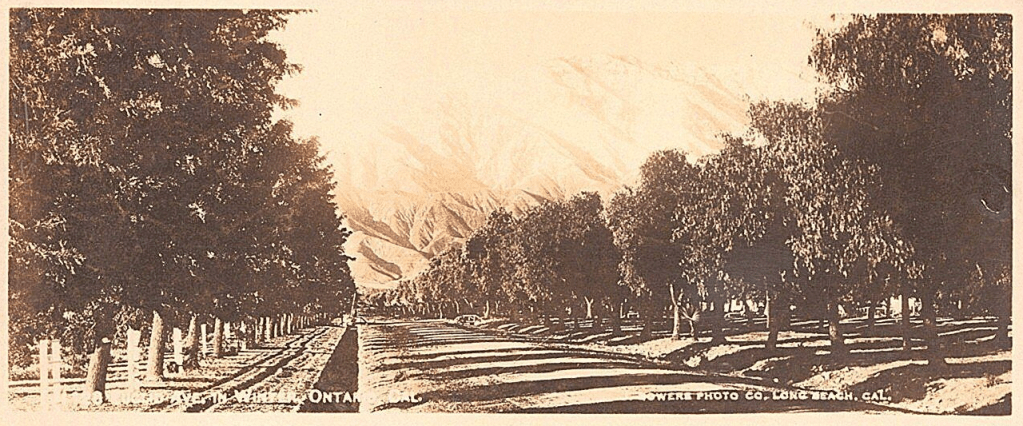
“Euclid Avenue in Winter,” circa 1905-1910. Photographer: John Bowers. (1865-1911)
Pre-1923 public domain postcard. No known copyright restrictions.

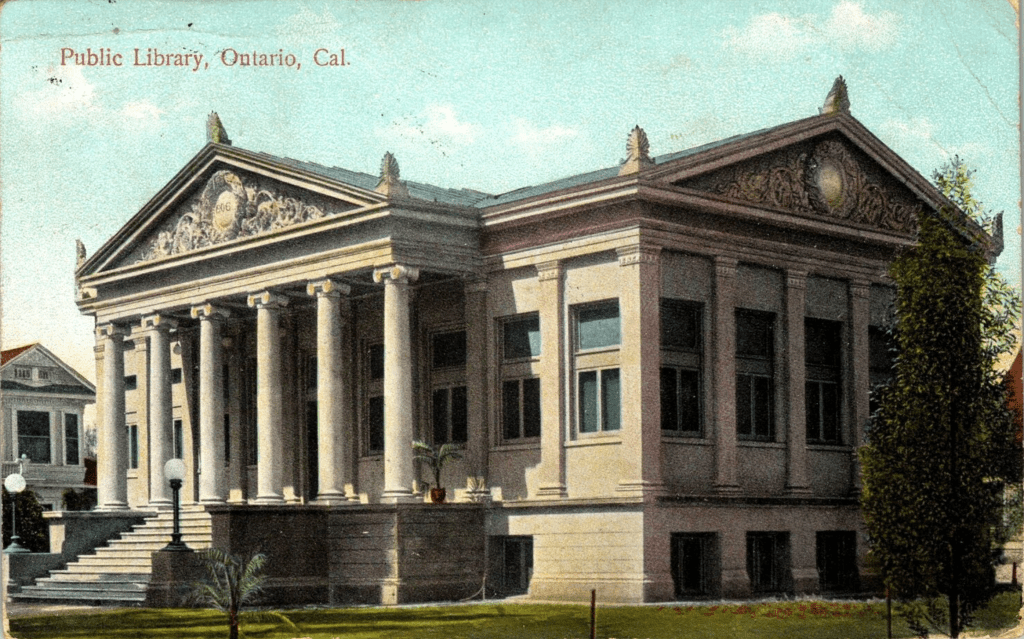
In 1903, the “Ontario Public Library” requested assistance from philanthropist Andrew Carnegie to secure funds for the construction of a new library building. In April 1906, after receiving a donation of $10,000 towards the project, the head librarian, Miss Kezzie A. Monroe, visited the Covina Public Library in California, which had opened in 1905. She gathered ideas from the library tour, and Architect F.P. Burnham was hired to prepare plans for the new Ontario library building. On April 13, 1907, the new library building located at D Street and Euclid Avenue opened, stocked with approximately 3,400 volumes with plenty of room for growth.
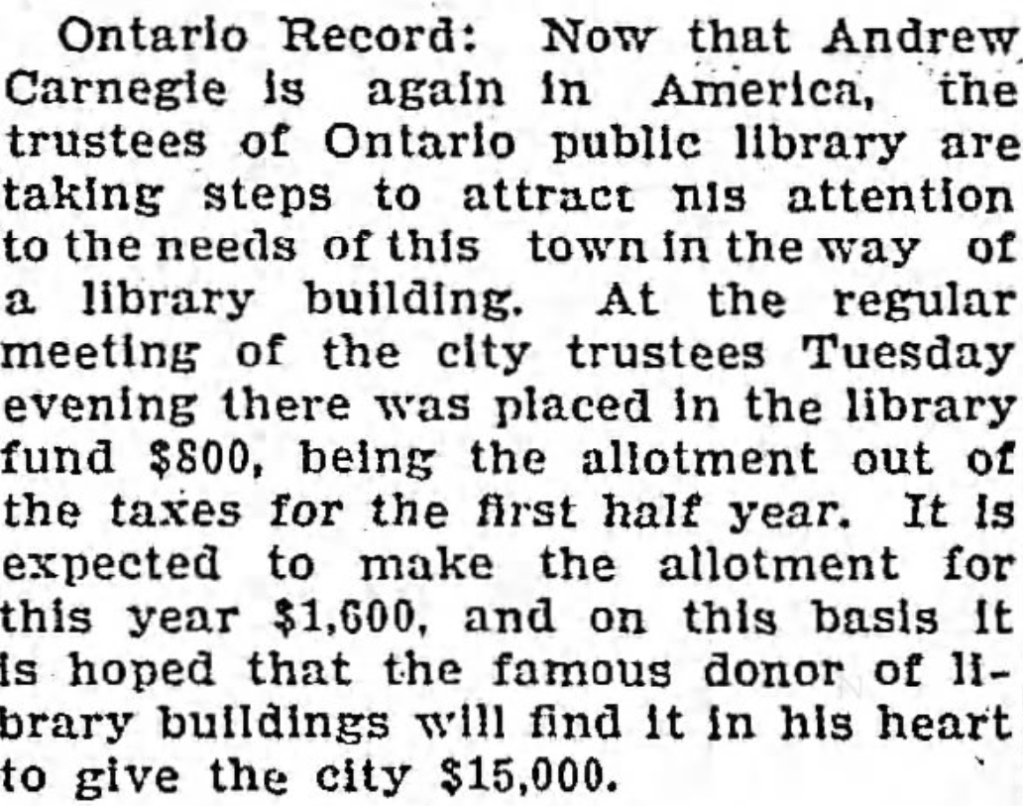
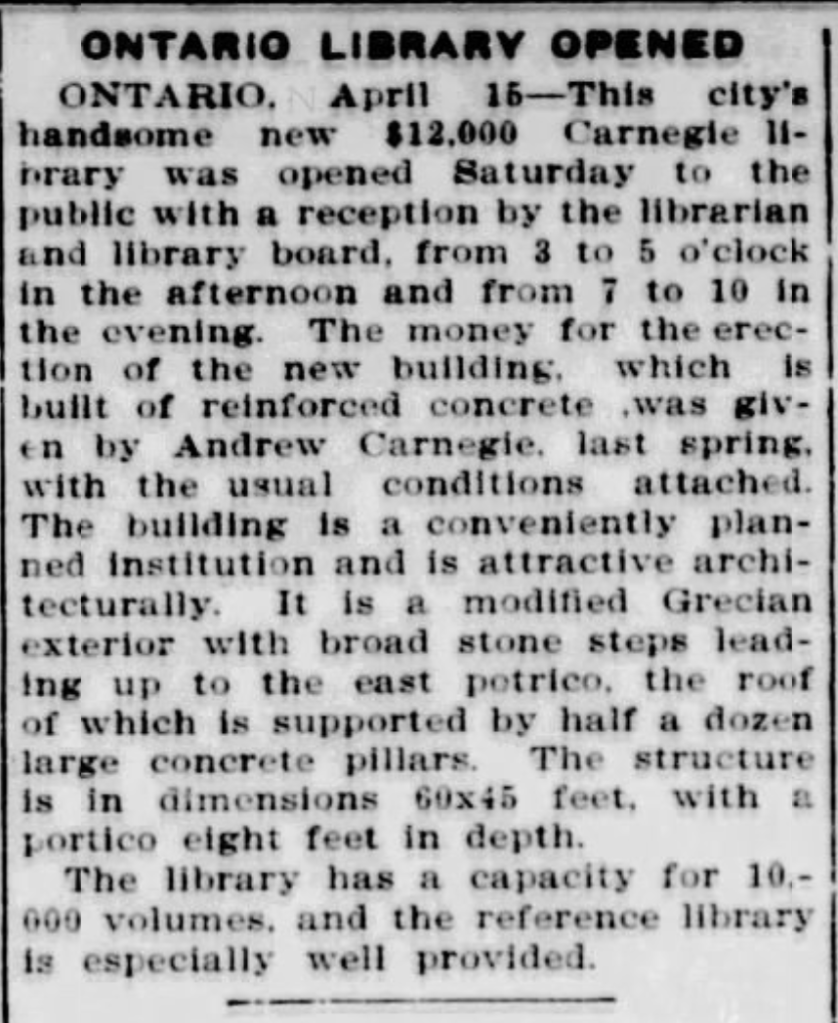
Daily Times-Index, 26 Jan 1903, Mon ·Page 2
Long Beach Tribune, 16 Apr 1907, Tue ·Page 2
Ontario Public Library. Pre-1923 public domain postcard. No copyright restrictions.

Over the next decade, the library saw steady growth in inventory and readership, and, once again, additional space was needed, as reported by the head librarian, Miss Monroe, in the 1919 annual report. 

Los Angeles Evening Express, 29 Jul 1919, Tue ·Page 2

In the meantime, the Library faced trials and tribulations, such as unwanted neighbors, bees, and pests! Oh my!

The San Bernardino County Sun, 07 Apr 1921, Thu ·Page 11

As a result of vigorous action by the community to halt the conversion, Mr. Owen announced that he had “no desire to offend the people of Ontario and would place the property on the market and seek another site.”1

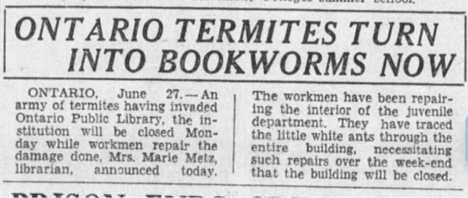
The Pasadena Post, 16 May 1929, Thu ·Page 17
The Los Angeles Times, 29 Jun 1930, Sun ·Page 52

On July 22, 1932, the newly expanded (and insect-free!) Carnegie Library building was opened to the public. The new wing, designed by Los Angeles Architect Harry L. Pierce, nearly doubled the floor space and reading rooms.

By mid-1943, the Library Board again proposed constructing a new library building. However, the selection of a new site would prove daunting. In April 1948, the Board purchased an additional lot adjoining the library property at D Street and Euclid Avenue, but an ongoing disagreement regarding the new library’s location lingered. In October 1953, the City Planning Commission approved a site at G Street and Euclid Avenue. However, having never officially reached an agreement for a new location, the library eventually fell into disrepair, and in July 1959, the library building was closed to the public, forcing the librarian to process loans and returns at the front door.
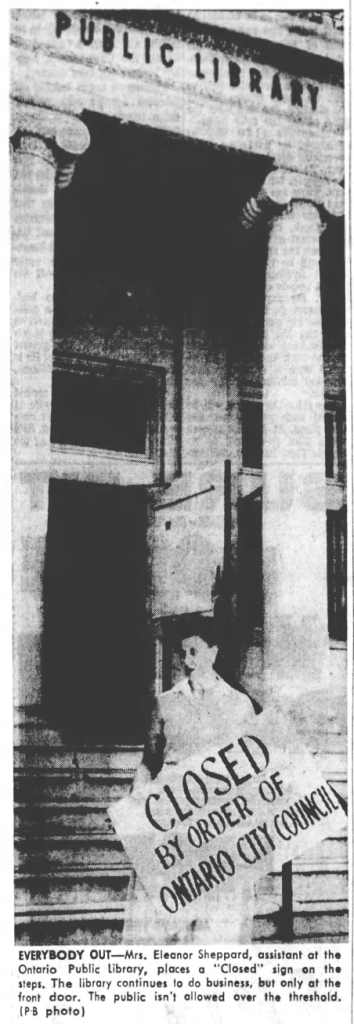
Progress-Bulletin, 29 Jul 1959, Wed ·Page 61

By August, the former Jack Clark Buick Co. building at 302 E. B Street was leased for use as a temporary library location. The building included a showroom, garage, and a much-needed parking lot. The temporary quarters opened on September 15 after the building’s interior was revamped for use as a library by the installation of new library shelving and 700 ft. of new fluorescent lighting. The former showroom was converted into the main reading room, and the builk of the library’s 60,000 volumes was available in the former garage.
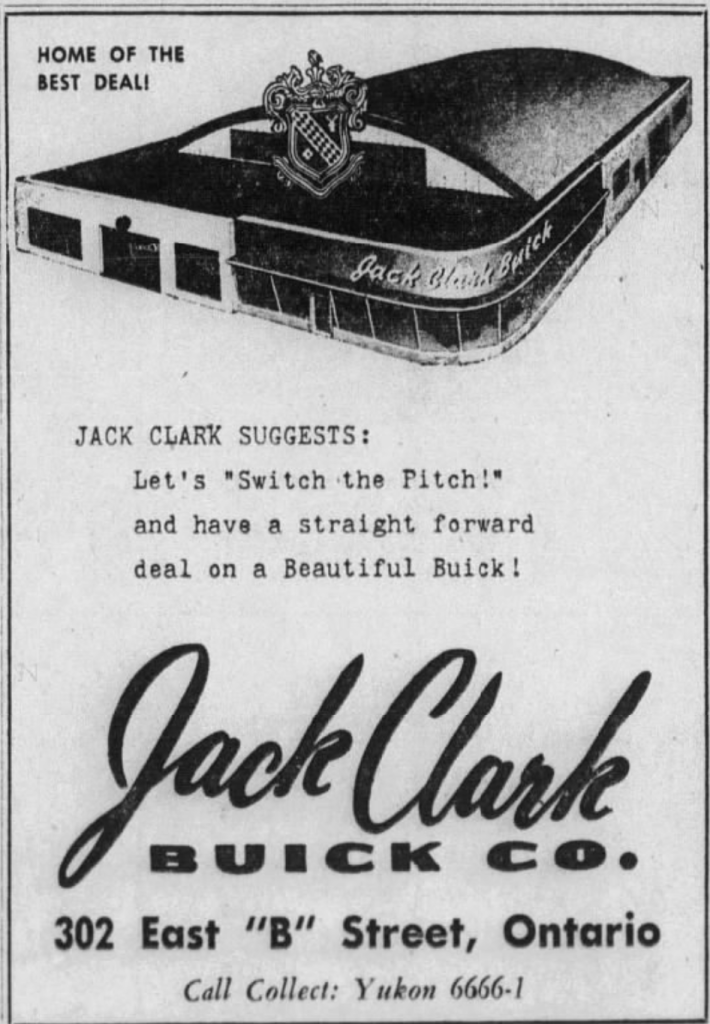
Jack Clark Buick Co. Newspaper Advertisement, The Los Angeles Times, 12 Jun 1955, Sun ·Page 162
Site of the temporary library, the Jack Clark Buick Co. building, Progress-Bulletin, 05 Aug 1959, Wed ·Page 57

Plans for the construction of a permanent library building on the north side of C Street between Lemon and Plum Avenues were put into motion almost immediately. By February 1960, a construction contract had been awarded to the Campbell Construction Co. of Ontario. The new library was opened to the public in mid-December 1960 and formally dedicated on January 16, 1961.

Architect’s (Dewey Harnish & Associate) rendering of the new library, Progress-Bulletin, 29 Apr 1960, Fri ·Page 21
Early 1960s postcard of the Ontario City Library. Publisher: Columbia Wholesale Supply. No known copyright restrictions

Library expansion was back in the news by April 1968 when voters overwhelmingly approved a $370,000 bond for the project. Architects Harnish, Morgan & Causey were contracted, and the expansion project began in January 1969. As part of a multi-phase plan, the library would eventually extend to the east of Plum Street. The library was expanded from 18,500 to 42,500 sq ft and was dedicated on March 1, 1970. 
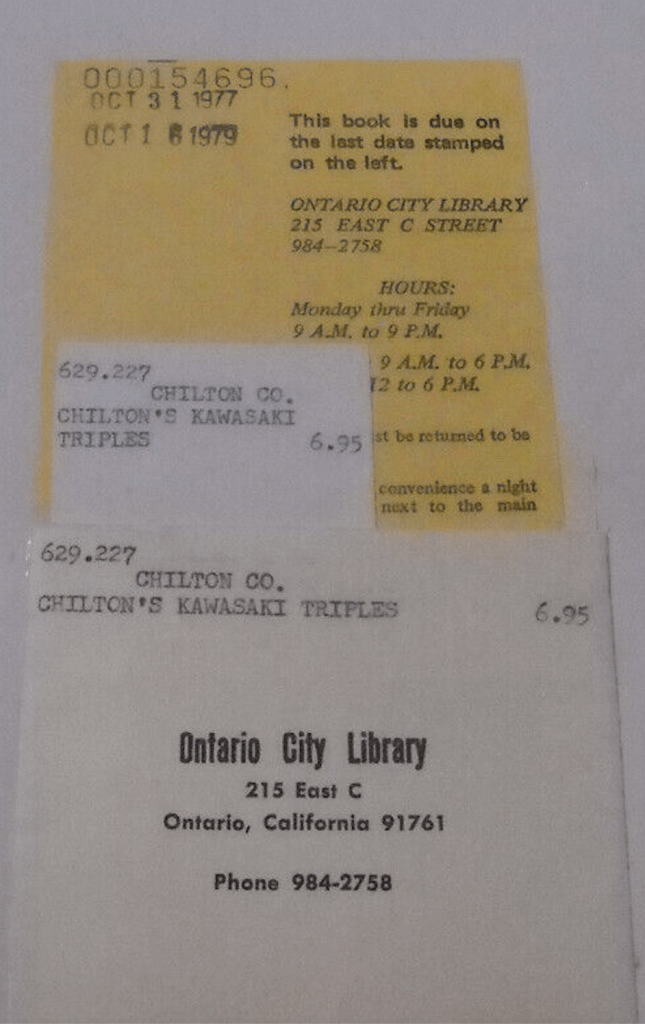
Late 1970s Ontario City Library card pocket and due date slip

In 2002, the library began another expansion project, which would add an additional 11,000 sq ft. During the construction, the library was temporarily housed at the Ontario Ranch Market at 120 E. D Street. Purchase, renovation, and relocation to the temporary location cost upwards of $3M.

The Ontario City Library after renovations (2006) Photo by Rockero (Wikimedia Commons). Public Domain – no copyright restrictions.

In 2010, the Ontario City Council renamed the library to the Ovitt Family Community Library in honor of the Ovitt family’s years of service to the city of Ontario. The Ovitt Library continues to operate at 215 E. C Street in Ontario.

San Diego Public Library, San Diego, California

Pre-1937 San Diego Public Library Borrower’s Card No. 75273 issued to Lee R. Moore

Pre-1937 San Diego Public Library Borrower’s Card No. 75273 issued to Lee R. Moore (front)
Pre-1937 San Diego Public Library Borrower’s Card No. 75273 issued to Lee R. Moore (back)

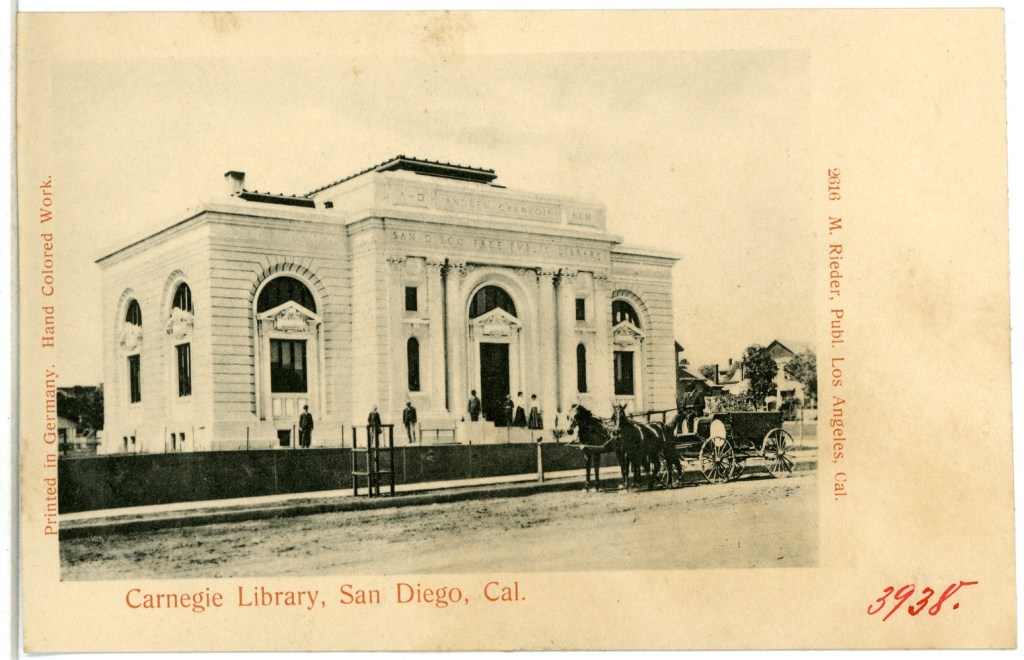
San Diego Public Library

San Diego Public Library (pre-1923 public domain postcard)

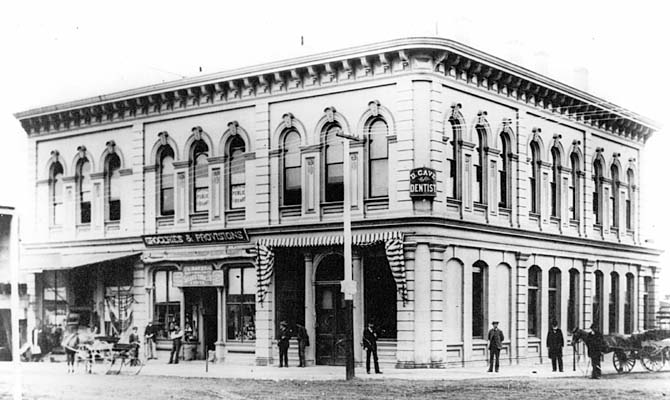
Opened to the public on July 15, 1882, the San Diego Public Library’s first location was the Commercial Bank building (aka the Consolidated National Bank) at 5th and G Streets.  The use of rooms on the 2nd floor2 was provided to the library non gratis for the first six month,1 after which rent was paid from the $650 city appropriation.

Commercial Bank Building (pre-1923 public domain photo; photographer unknown)

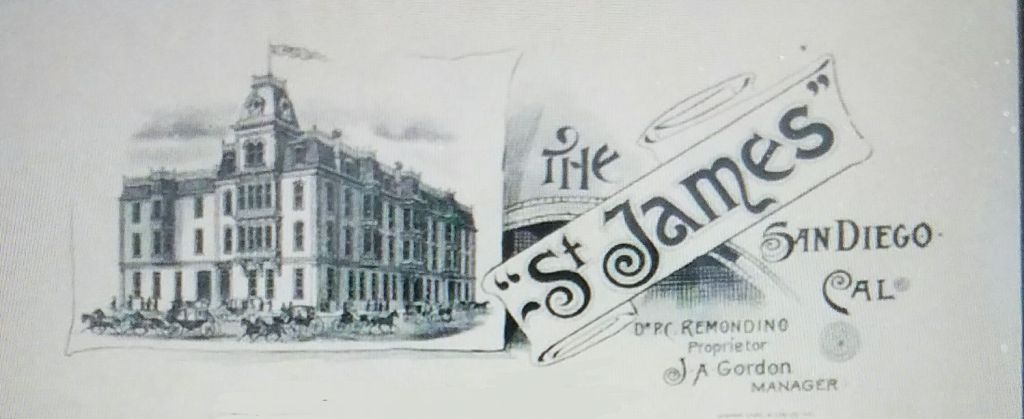
In 1893, the library was moved once again to the fashionable St. James Building at 7th and F Streets and would remain there for at least five years.3

Drawing from a 1890’s St James Hotel breakfast menu (No known copyright restrictions)

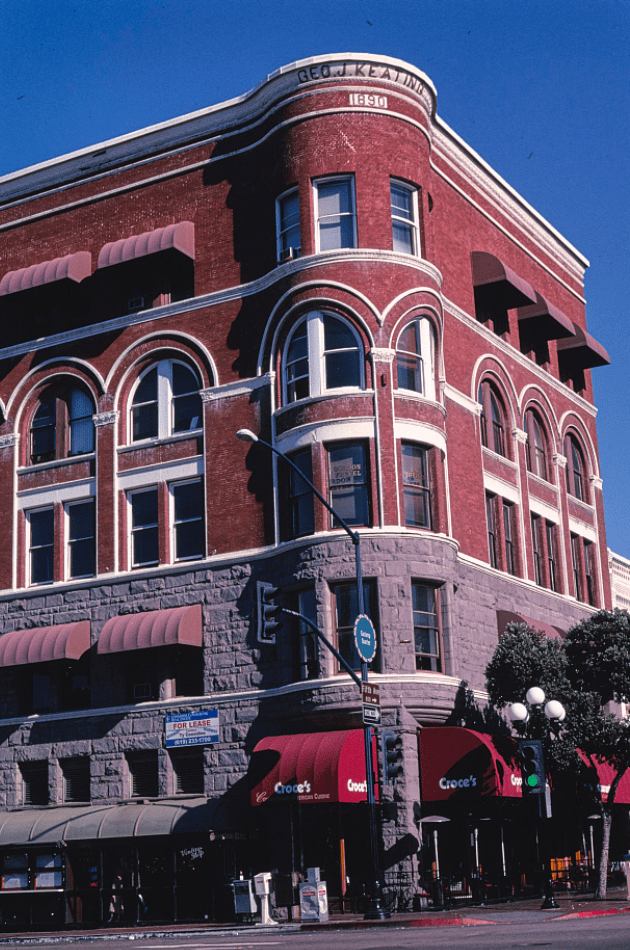
By 1898, the library began to outgrow its accommodations, so arrangements were made for space on the 4th floor of the new Keating Building at Fifth and F Streets.  Rent increased from $50 to $85, but the rooms were more spacious and well-lit, and a modern elevator made access to the library much easier.4 The Keating Building was designed by George J. Keating, founder of a farm equipment company, and built in 1890 by his wife, Fannie, after his death on June 25, 1888.


Keating Building.  Photo by John Margolies.  No known copyright restrictions.   From the John Margolies Roadside America photograph archive (1972-2008), Library of Congress, Prints and Photographs Division

While the Keating Building provided adequate square footage to accommodate the growing library, library space had been a concern several years prior to the move into the Keating Building.   Efforts to raise funds for the building of a permanent home large enough to house the growing library was undertaken by the Ladies’ Wednesday Club as early as 1896.5. But it wasn’t until mid-1899, that a new library building became a realistic goal.  In response to a letter sent to the Andrew Carnegie Corporation by library trustee, Mrs. Lydia K. Horton, in which she asked for photographs of previously built Carnegie libraries in hopes that the photographs would spark interest by her fellow trustees, the Carnegie Corporation promised a $50,000 grant to build the first Carnegie library west of the Mississippi River.6  On April 23, 1902, the new library building opened at Eighth and E Streets.  The building designed by architects, Ackerman & Ross of New York, had room for 75,000 volumes and boasted a museum, art gallery, and lecture room. The Carnegie Library building would serve as the main library until 1952 when the building was razed to allow the construction of a new, modernized building. The new library opened at the same location on June 27, 1954. The current location of the San Diego Central Library is 330 Park Blvd. in San Diego.

San Diego Public Library and Comic-Con

Since 2013, the San Diego Public Library has partnered with Comic-Con and designed limited-edition comic-themed library cards, which are only available at the San Diego Public Library booth at the yearly Comic-Con convention in San Diego.  The 2019 card, of which only 3,000 were made available, features Waldo over an image of  the San Diego Central Library, which is located at 330 Park Boulevard in San Diego.  

2019 San Diego Public Library Special Edition Comic-Con Library Card and Keychain Card (front)
2019 San Diego Public Library Special Edition Comic-Con Library Card and Keychain Card (back)

Lee R. Moore

Lee Reed Moore was born August 7, 1921, in Kansas City; He was the son of Lee R. Moore, Sr  of Texas and Orpha Moore.  Lee R. Moore was a salesman for Ryan Aeronautical Co.  He died on April 29, 1980.

1 Catalog of the San Diego Free Public Library: Compiled by the Order of the Board of Trustees, by Lulu Younkin, April 1889

2 The Record (National City, California), June 11, 1885, p. 2

3 The Los Angeles Times (Los Angeles, California) April 5, 1893, p. 7

4 The Los Angeles Times (Los Angeles, California) April 7, 1898, p. 13

5 The Los Angeles Times (Los Angeles, California), December 7, 1896, p. 5

6 The Los Angeles Times (Los Angeles, California), July 18, 1899, p. 15

Los Angeles County Public Library, Burbank Branch, Los Angeles, California

Pre-1935 Los Angeles County Public Library, Burbank Branch, Library Card No. 21-29-90 issued to Dale Jolley

Pre-1935 Los Angeles County Public Library, Burbank Branch, Library Card No. 21-29-90 issued to Dale Jolley (front)
Pre-1935 Los Angeles County Public Library, Burbank Branch, Library Card No. 21-29-90 issued to Dale Jolley (back)

Originally the Los Angeles County Free Library, the Los Angeles County Public Library (LACPL) was established after the “County Free Library Act” was enacted in 1912. Shortly after, the Burbank Branch was opened in May 1913. The original location of the library was at the corner of Olive Avenue and San Fernando Road.

By 1921, with a growing inventory of over 500 volumes, the Burbank branch library relocated to a room in the City Hall. Due to growing demand, in July 1925, the library began to open its doors twice weekly, and Burbank City officials saw the need to build a new Library. In February 1926, a new Library and Chamber of Commerce building opened at 219 North Olive Avenue.

By the 1930s, Burbank experienced rapid growth, which prompted city officials to make plans to detach from the Los Angeles County Public Library and open a municipal-owned library. In April 1934, three lots were purchased on Olive Avenue. Construction funds were raised locally, and books needed to stock the library were donated by Burbank residents. Eventually, all LACPL materials were returned, and in September 1938, the new city-owned library opened at 425 East Olive Avenue stocked with over 5,000 volumes.

By the end of the 1950s, multiple branch libraries opened with 7,000 to 10,000 volumes each, including the Buena Vista (Carolyn See, librarian), West Burbank, and North Glenoaks Branch Libraries.

In July 1963, a new two-story modernized building opened.

Article from the Los Angeles Times, Los Angeles, California, June 16, 1963.

The new building had a capacity of 200,000 volumes and four times the space of their former location at 425 East Olive Avenue, which was razed. The Central Library continues to operate from the Olive Avenue location.

Dale M. Jolley

Dale Marion Jolley was born in 1921 in Paul, Idaho. He graduated from Burbank High School in 1940. After high school, Jolley was signed by the Music Corporation of America as a saxophonist. He became a member of the Freddie Nagel Band and recorded with the Jack Teagarden Orchestra on recordings such as Big “T” jump in 1944. During the 1960s, Jolley gave private clarinet and saxophone lessons. Dale Jolley died in 1985 at the age of 63.

Los Angeles Public Library System, Helen Hunt Jackson Branch, Los Angeles, California

Pre-1944 Los Angeles Public Library System, Helen Hunt Jackson Branch, Library Card No. 4H 3669 issued to Mrs. Clara M. Cota

Pre-1944 Los Angeles Public Library System, Helen Hunt Jackson Branch, Library Card No. 4H 3669 issued to Mrs. Clara M. Cota (front)
Pre-1944 Los Angeles Public Library System, Helen Hunt Jackson Branch, Library Card No. 4H 3669 issued to Mrs. Clara M. Cota (back)

Los Angeles Public Library, Helen Hunt Jackson Branch

In the mid 1920s, community growth began to strain the existing Central Branch of the Los Angeles Public Library System.  Accordingly, the Helen Hunt Jackson Branch opened to the public on November 1, 1925 at Naomi Avenue and 25th Street in Los Angeles.  Named after the 19th Century American writer, Helen Hunt Jackson (1830-1885), who penned the classic novel, Ramona, which told the story of a romance between Ramona, a Scottish-Native American orphan girl and Alessandro, a Native American sheep herder, set during the days of the California missions. The novel had significant positive impact on the cultural image of Southern California. The Spanish Colonial Revival building was designed by C. E. Noerenberg and boasted a 25’ x 26’ main reading room, a separate 22’ x 23’ children’s reading room, and a community room and kitchen. 

In 1940, the Helen Hunt Jackson Branch ceased operations as a fully staffed branch library and was converted to a station with a shortened, weekly 21-hour operating schedule.  Eventually, the Helen Hunt Jackson Branch ceased operating as a library and was eventually converted into a church building (Rock of Salvation Church).

In 1987, the Helen Hunt Jackson Branch and several other branch libraries in Los Angeles were added to the National Register of Historic Places.  

1925 photo of Los Angeles Public Library System, Helen Hunt Jackson Branch, at Naomi Avenue and 25th Street in Los Angeles, California (Photo from the SPNB Collection – Los Angeles Public Library Photo Collection and used in accordance with Title 17 U.S.C. Section 107 and the Doctrine of Fair Use)

Miriam Matthews

Miriam Matthews (1905-2002) was the first African American Librarian for the Los Angeles Public Library System, and the state of California.  Called the “Dean of California Black History,” Matthews was instrumental in the creation of Black History Month.  During her tenure at the Helen Hunt Jackson Branch, Matthews found a small cache of books devoted to black history in California.  She then began researching and preserving the contributions of African Americans to California history and created the Los Angeles Public Library System’s first research collection on Black History.  

In 1926, Miriam Matthews earned a Bachelor’s degree, followed by a Certificate in Librarianship in 1927 from UC Berkeley.  After graduating, Matthews passed California’s civil service exam despite attempts by civil service administrators to sabotage her efforts.  In July 1927, Matthews began working  as a Substitute Librarian at the Los Angeles Public Library System’s Robert Louis Stevenson Branch, and within three months, became a full-time Librarian.  Matthews remained a branch librarian until taking a leave of absence to earn a Master’s degree in Library Science from the University of Chicago in 1945.  After returning to Los Angeles, she was promoted to regional librarian and supervised a dozen branch libraries.  Matthews worked with the Los Angeles Public Library System from 1927 until her retirement in 1960. 

Merced County Free Library, Gustine Branch, Gustine, California

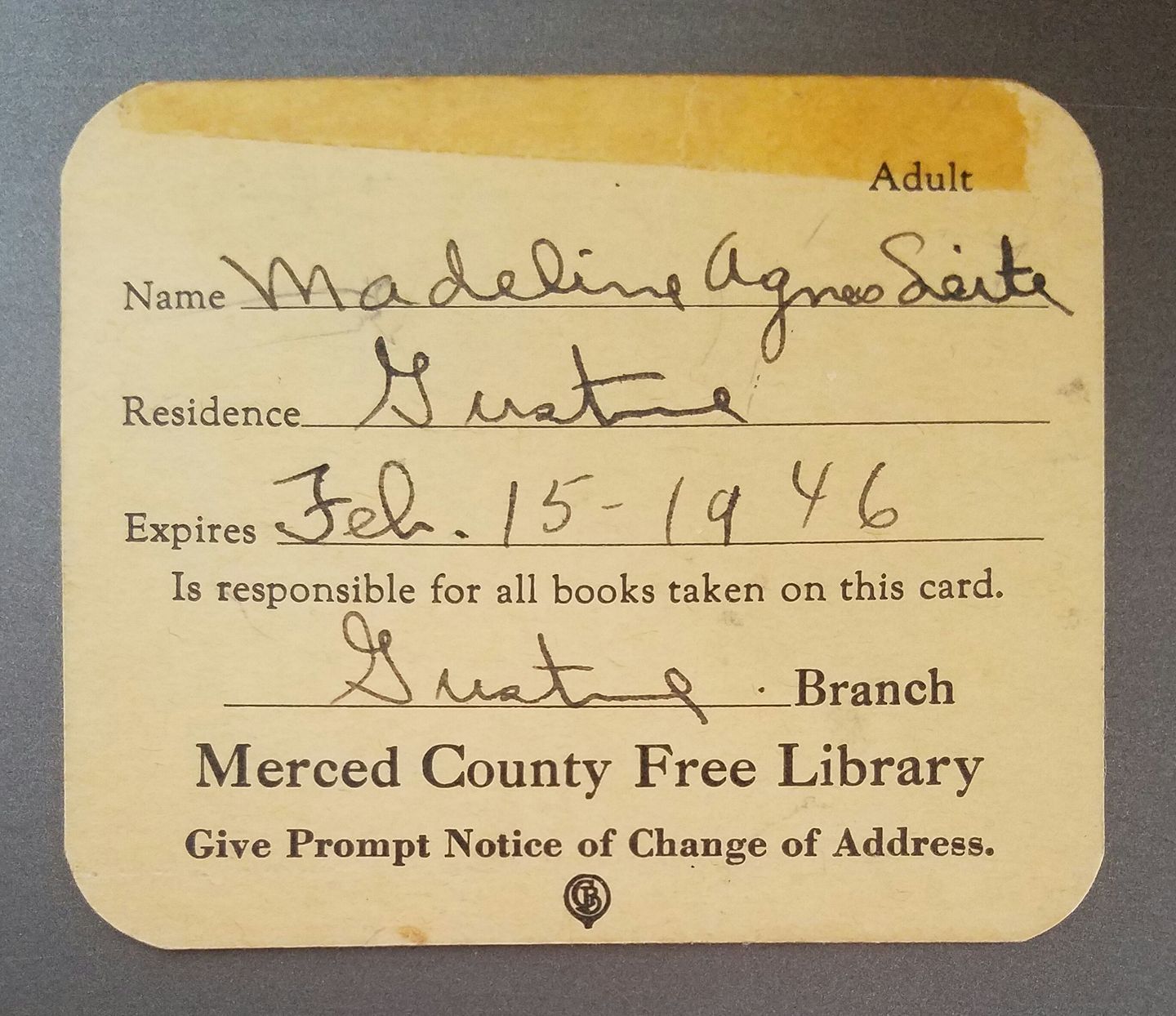
Pre-1946 Library Card issued to Madeline Agnes Leite

1946 Merced County Free Library Card (front)

Merced County Free Library

The Merced County Free Library’s Gustine Branch, opened in November 1910.  Born from the donations of benefactors, including the Merced County Ladies Library, a membership social library which operated out of Nelson Cody’s (Buffalo Bill’s cousin) Corner Drug Store at 17th and Canal Streets in downtown Merced.  The initial offering of 500 volumes were donated by Nelson’s wife, Anna Marie Nelson Cody, and were located in a back room at the Park Restaurant.  The Gustine Branch relocated in 1948 to 6th Street and 2nd Avenue at Henry Miller Park where it still operates.

Madeline Agnes Leite (1928-2009)

Madelyn Agnes Silva “Mattie” Leite Amaral was a California native and advocate for disabled persons.