Havana Military Academy, Biblioteca Rafael Maria Mendive, Havana, Cuba

Pre-1960 Book Pocket and Book Card, Havana Military Academy, Biblioteca Rafael Maria Mendive

Pre-1960 Book Pocket with Book Card for Victor Hugo’s biography of William Shakespeare, Havana Military Academy, Biblioteca Rafael Maria Mendive
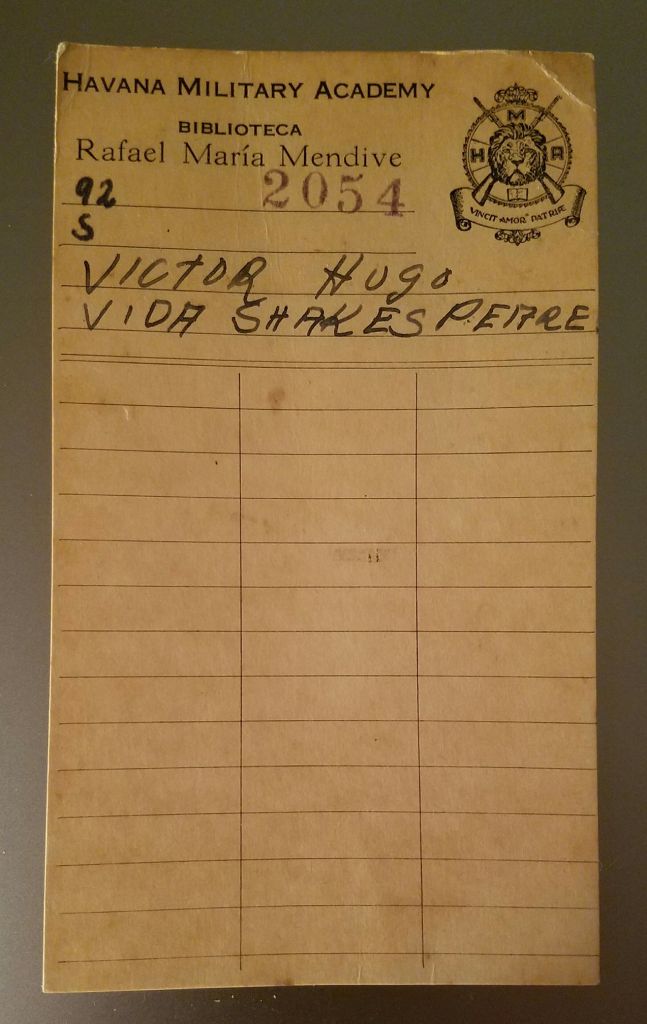
Pre-1960 Book Pocket, Havana Military Academy, Biblioteca Rafael Maria Mendive
Pre-1960 Book Card for Victor Hugo’s biography of William Shakespeare, Havana Military Academy, Biblioteca Rafael Maria Mendive

The Havana Military Academy, Havana, Cuba

The Havana Military Academy, founded by Raúl Chibás in 1947 before the Cuban Revolution, was an elite military-style boarding school on the outskirts of Havana, Cuba.
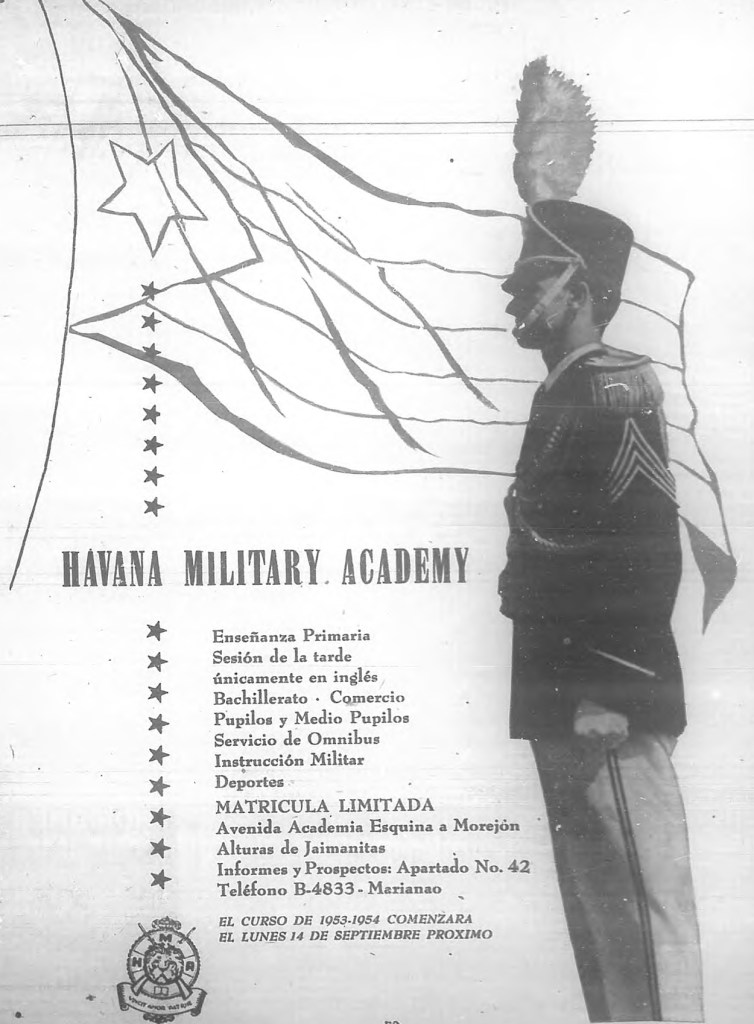
Advertisement for the 1953-1954 School Season of the Havana Military Academy, Havana, Cuba

The 1947 Montreal Royals

Before opening to students in late 1947, the Academy famously hosted the Brooklyn Dodgers and their AAA farm team, the Montreal Royals, for their 1947 spring training season. After having experienced racial harassment from white crowds in Daytona Beach during the 1946 Spring training season due to the Royals’ integrated roster that included the first black minor league player, Jackie Robinson, management decided to change the training location to Cuba after learning that baseball teams in Cuba had been integrated since the early 1900s. However, Jim Crow laws followed Robinson and the Royals to Havana. While the Dodgers stayed at the swank Hotel Nacional and the Royals at the brand-new Havana Military Academy, Jackie Robinson and other African American teammates were given accommodations at a third-rate boarding house in downtown Havana. This unfair treatment didn’t deter Jackie Robinson from making baseball history. In the 1947 regular season, Jackie Robinson was signed to the Brooklyn Dodgers and became the first African American major league baseball player in American baseball history, as well as the Rookie of the year. With Robinson’s help, the Dodgers went all the way to the 1947 World Series.
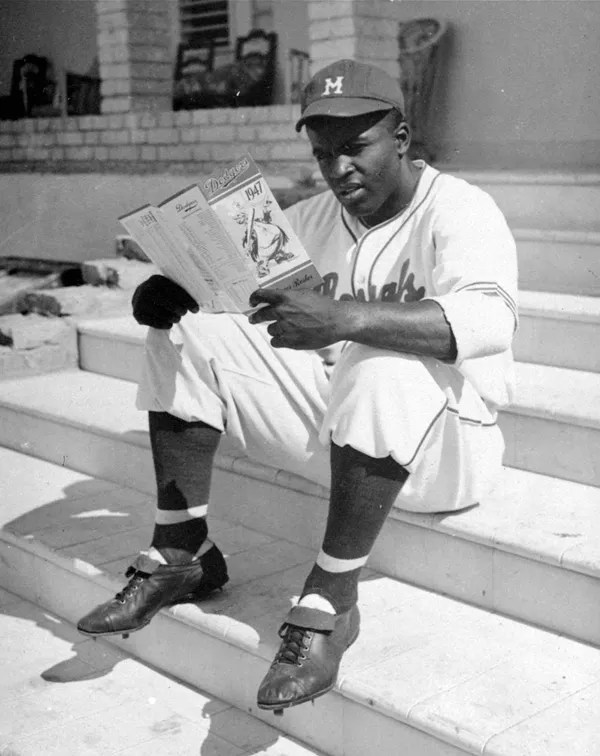
Jackie Robinson reading the 1947 Montreal Royals’ roster.
(Associated Press/public domain)

The Cuban Revolution of 1953

Before the Cuban Revolution, Cuban politics were rife with corruption, dictatorships, and episodic American intervention and interference. The Cuban economy, at times robust due to the growing exports of sugar to the United States, continually fluctuated and ultimately stagnated because of restrictive trade policies introduced by the Smoot-Hawley Tariff Act in 1930.

In 1933, the Sergeants’ Revolt, a coup led by Fulgencio Batista, resulted in the deposition of President Carlos Manuel de Cespedes and the introduction of a United States-backed military dictatorship. While the economy prospered under Batista, so did social ills and inequalities. Cuba became known for its decadence, a destination for prostitution and gambling at mafia-infested casinos. Moreover, while the economy under Batista was burgeoning for many, the underclass was experiencing extreme poverty and unemployment. In 1952, a young attorney named Fidel Castro petitioned the courts to overthrow the presidency of Batista due to his corruption, but Castro’s arguments were not persuasive. It was then that Castro concluded that more aggressive steps were needed to rid Cuba of an administration he saw as tyrannical. With the help of his brother Raul, Castro organized a paramilitary organization called “The Movement,” and by the end of 1952, had recruited over 1,200 followers. In 1953, a failed attempt at stealing weapons from a military garrison landed Castro in prison for 15 years, but he was released early due to international pressures. Upon his release, Castro traveled to Mexico to receive paramilitary training and, while there, met a young militant revolutionary named Che Guevara. Guevara joined forces with Castro, and both returned to Cuba to begin the revolution in earnest. On November 25, 1956, Castro, Guevara, and other supporters crash-landed a small yacht onto the shores of Playa Las Coloradas. After a brief but lethal attack by Batista’s army, they fled into the mountains, where they continued plans for a coup. In response to the growing revolutionary movement, Batista solicited the help of the United States to combat the rebels, but the United States played both hands and supplied support to the rebels, as well, sensing the need to establish a relationship should Castro’s revolution be successful. From 1957 through 1958, there was a dramatic shift in public support for the revolution. Batista’s public approval was dwindling, and an arms embargo by the United States further weakened Batista’s military powers. On January 1, 1959, Batista fled Cuba, and Fidel Castro’s first appointed President, Manuel Urrutia Lleo, took office on January 3, 1959. In a speech by Fidel Castro on November 28, 1960, Castro spoke of the Havana Military Academy that had been abandoned by Raúl Chibás upon his defection to the United States. “A gentleman left, leaving a school behind called the Havana Military Academy. Now we are adding to it, and it will be the first rebel army polytechnic school for the revolution … and it has the manpower to do all the tasks and achieve all the goals it proposes.”

Rafael Maria de Mendive

Rafael Maria de Mendive (1821-1886) was a Cuban poet, and mentor to José Marti (1853-1895).

Rafael Maria de Mendive (public domain)

Havana Military Academy Educators and Students

Raúl Chibás

Raúl Chibás (1917-1998), founder of the Havana Military Academy and a long-time critic of the Batista administration, joined Fidel Castro’s revolutionary movement in 1957. Politics was no stranger to the Chibás family. His brother, Eddy Chibás, was the founder of the Partido Ortodoxo in Cuba, a former Senator, and a controversial radio talk show host who committed suicide on air in an act of political contrition. Raul, believing that Castro was the answer to the overthrow of President Batista and the advent of democracy in Cuba, joined Castro in the Sierra Maestra Mountains, where he co-authored the Sierra Maestra Manifesto, laying out the democratic intentions of the revolution. But Castro, needing the support of those with less radical leanings like Chibás, concealed his communist intentions. After the revolution, Chibás became disillusioned with Castro’s authoritarianism and defected to America in August 1960.

Félix Rodríguez

Félix Rodríguez (b. 1941), also known as Félix “El Gato” Ramos Medina, was a Havana Military Academy graduate recruited by the Central Intelligence Agency shortly after his defection to the United States in 1960. In 1961, Rodríguez slipped back into Cuba to prepare for the covert Bay of Pigs operation, but due to the mission’s failure, he sought refuge at the Venezuelan embassy before he was allowed to leave Cuba. Rodríguez was involved in many CIA-backed operations, but he is most well-known for his participation in the assassination of Che Guevera on October 9, 1967, and arms trafficking for the CIA and the Nicaraguan Contras.

Manuel Artime

Manuel Artime (1932 –1977), a professor at the Havana Military Academy, was a former member of Castro’s rebel army. In 1959, after becoming disillusioned by Castro’s increasingly communist leanings, he formed a counter-revolutionary group called the Movimiento de Recuperación Revolucionaria (MRR). However, fearing assassination by Castro’s army, Artime defected to the United States with the help of the American embassy and the CIA. After defecting, Artime was recruited by the CIA and became the leader of the Bay of Pigs resistance fighters and other anti-Castro campaigns, including a failed assassination attempt against Fidel Castro in 1965. In the 1970s, Artime organized the Miami Watergate Defense Relief Fund, collecting money for the convicted Watergate burglars, several of whom were American or Cuban veterans of the Bay of Pigs operation. Artime died suddenly on November 18, 1977, before his scheduled appearance before the House Select Committee on Assassinations to give testimony on the John F. Kennedy assassination.
The Harvard College Library, Cambridge, Massachusetts

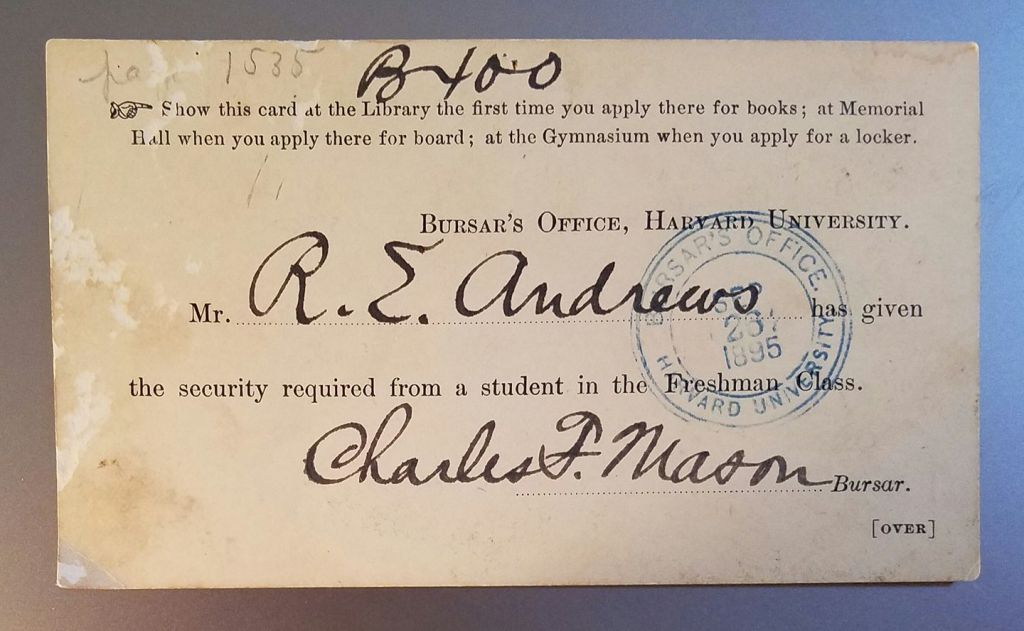
1895 Harvard University Bursar’s Office Freshman Security Receipt issued to R. E. Andrews

Harvard University Bursar’s Office Freshman Security Receipt for library privileges dated September 23, 1895 issued to R. E. Andrews (front)
Harvard University Bursar’s Office Freshman Security Receipt for library privileges dated September 23, 1895 issued to R. E. Andrews (back)

Founded in 1636, Harvard College (now Harvard University) and Harvard College Library is the oldest University and private and academic library in the United States.

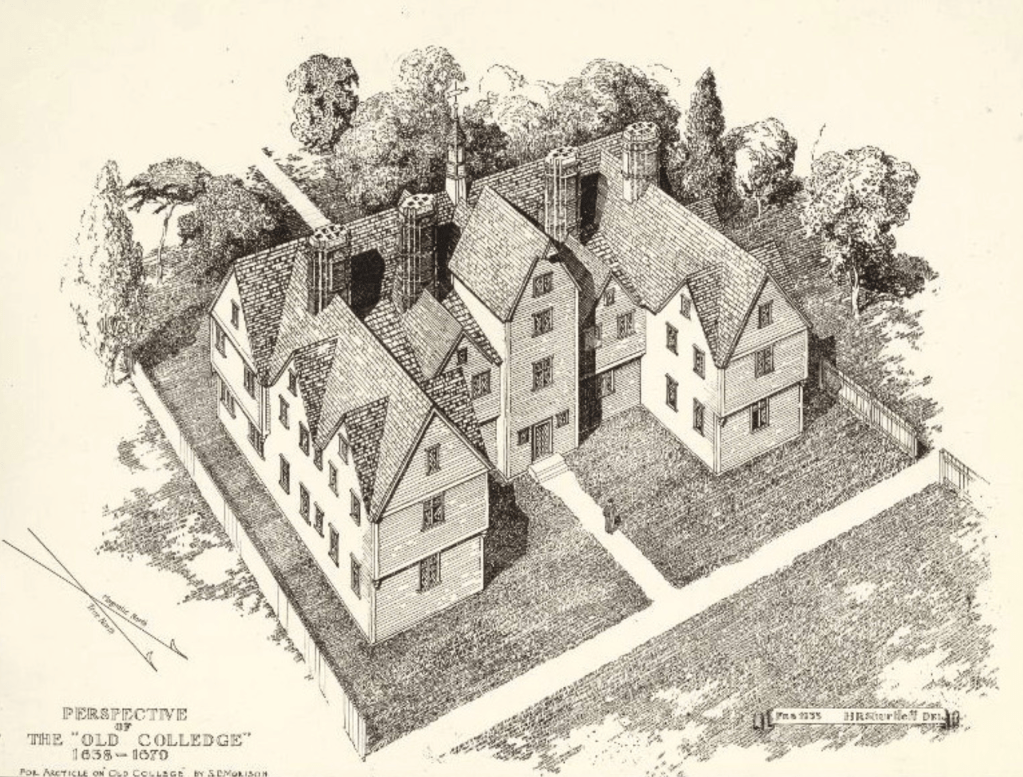
Established through personal donations from the University’s namesake, John Harvard, a Puritan minister who bequeathed over 400 religious texts to the College on his death, the Library was initially located at the Old College building.

The Old College. From the Harvard University Archives,
Records of Early Harvard Buildings. No known copyright restrictions.

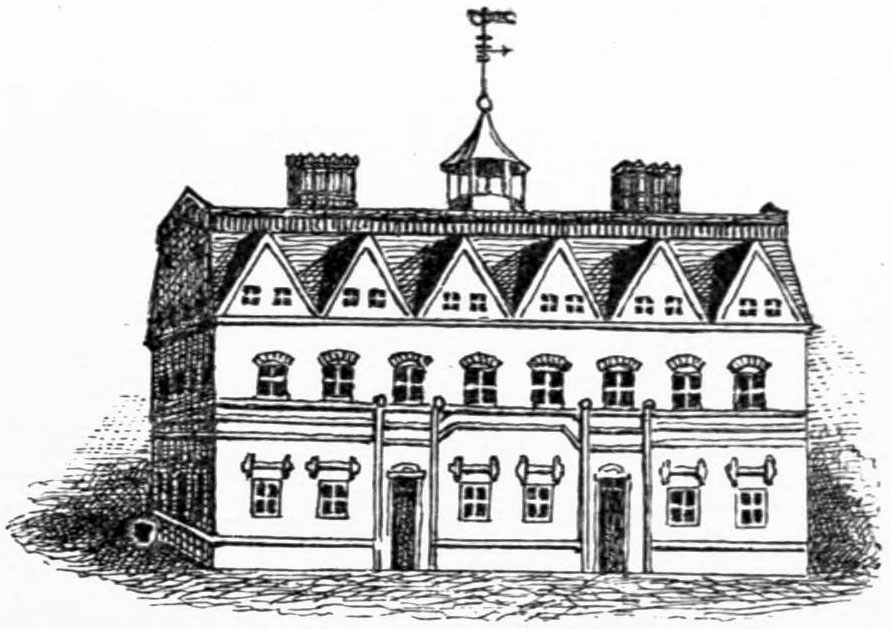
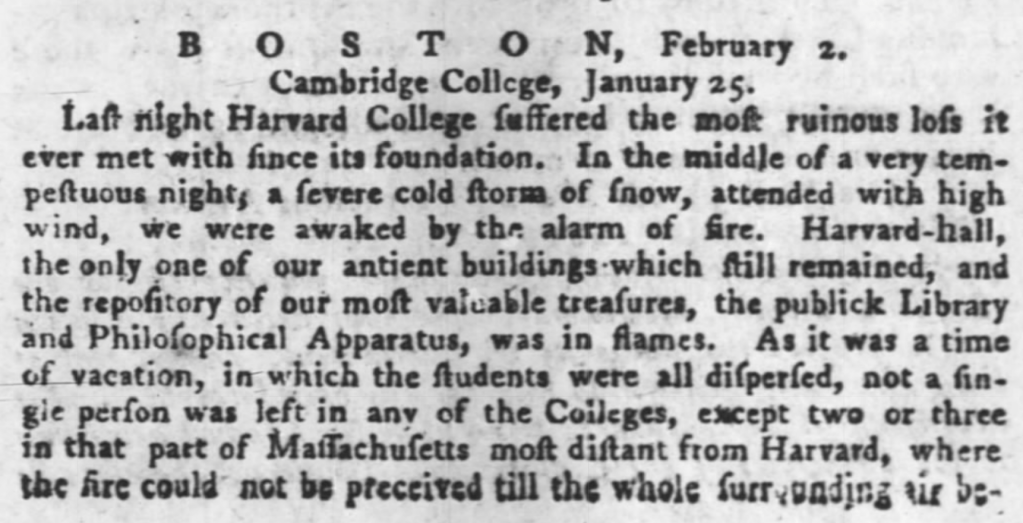
In 1676, The Library moved to Harvard Hall, where it remained for nearly 100 years until the building and library collection was destroyed by fire in 1764.

The original Harvard Hall destroyed by fire on January 24, 1764. Location of the Harvard College Library from 1676 to 1764. Artist unknown. No known copyright restrictions.
News article detailing the fire of 1764. The Pennsylvania Gazette (Philadelphia, Pennsylvania), February 23, 1764. No known copyright restrictions.

Rebuilt in 1766, the Library reopened with a new inventory of over 15,000 volumes, an inventory primarily donated by Thomas Hollis of England and books that were re-collected from students after the fire. Harvard Library’s online catalog system, HOLLIS (Harvard On-Line Library Information System), is thus named in his honor. Through a generous endowment provided by Hollis upon his death in 1774, the Library was able to continue purchasing books for the library, thus maintaining its position as the most extensive library in the United States. 

Harvard Hall, rebuilt in 1766. Location of the Harvard College Library from 1766 to 1841.
Pre-1925 public domain postcard.

Due to this continued growth, the Library moved once again in 1841 to Gore Hall. By 1912, Gore Hall was no longer suitable to hold the ever-growing collection, so the Library was disbursed into smaller specialty libraries.  

Gore Hall. Location of the Harvard College Library from 1841 to 1912.
Pre-1925 public domain postcard.

Libraries of the Harvard Library System

 • Andover-Harvard Theological Library (1911)

 • Arnold Arboretum Horticultural Library (1903)

 • George F. Baker Library (1927)

 • Biblioteca Berenson (Florence, Italy) (1961)

 • Botany Libraries

 • Godfrey Lowell Cabot Science Library (1973)

 • Francis A. Countway Library (1958)

 • Dumbarton Oaks Research Library (Washington, DC) (1940)

 • Ernst Mayr Library of the Museum of Comparative Zoology (1861)

 • Fine Arts Library (1895)

 • H.C. Fung Library (2005)

 • Monroe C. Gutman Library (1972)

 • Harvard Film Archive (1979)

 • Harvard Kennedy School Library and Knowledge Services (formerly the Harvard Graduate School of Public Administration) (1936)

 • Harvard Law School Library (1817)

 • Harvard University Archives (1851)

 • Harvard-Yenching Library (1928)

 • Arthur A. Houghton Library (1942)

 • Thomas W. Lamont Library (1949)

 • Eda Kuhn Loeb Music Library (1976)

 • Frances Loeb Design Library (1969)

 • Robbins Library of Philosophy (1905)

 • Arthur and Elizabeth Schlesinger Library on the History of Women in America at Radcliffe (1943)

 • Alfred Marston Tozzer Library (1866)

 • Harry Elkins Widener Library (1915)

 • John G. Wolbach Library (1934)

At 15 million volumes, The Harvard College Library continues to hold one of the largest collections in the United States, surpassed only by the Library of Congress. 

Robert Eaton Andrews

Robert Eaton Andrews was born in Cambridge, Massachusetts, on May 4, 1878.  He earned his B.A. from Harvard University in 1899, and his M.D. from Harvard University Medical School in 1903. He was a resident of Springfield, Massachusetts, until his death in 1963.  

Charles F. Mason

Charles F. Mason (1860-1947), graduated from Harvard in 1882 and subsequently served as the Bursar of the University for 34 years from 1887-1921. 

Kelly High School Library, Chicago, Illinois

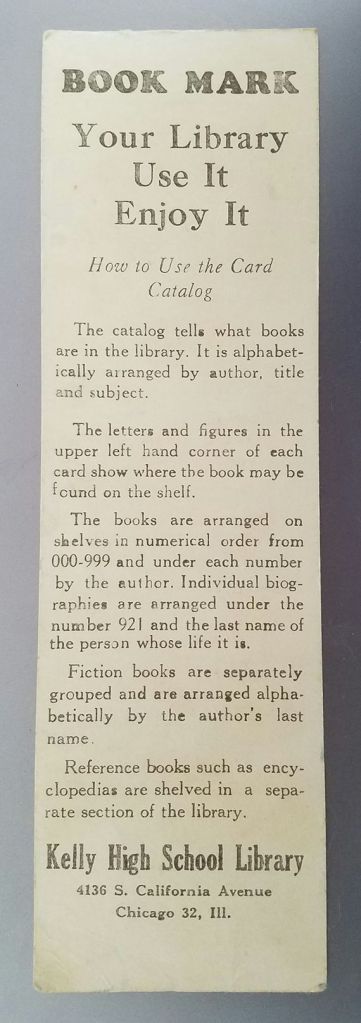
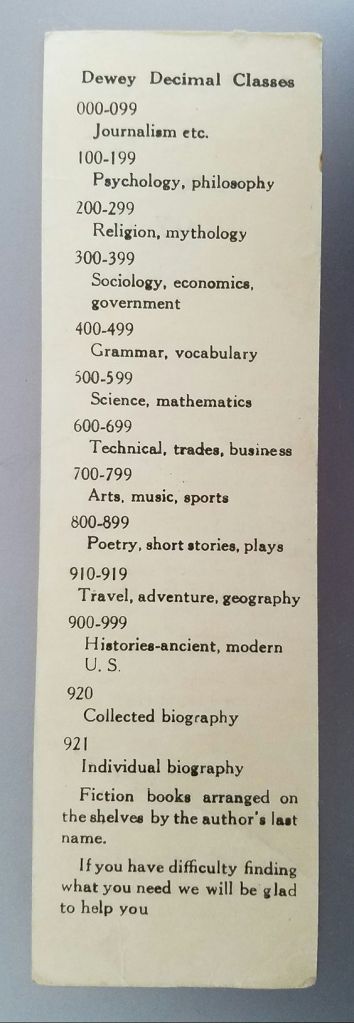
Pre-1943 Kelly High School Library Bookmark

Kelly High School, Chicago, Illinois

Named for Thomas J. Kelly, the Irish nationalist, Kelly High School located at 4136 S. California Avenue in Chicago, Illinois, opened in December 1928 as a junior high school, only serving grades six through ninth.  After the Board of Education abolished all junior high schools in Chicago in July 1933, Kelly began the1933 school year as a senior high school.  Kelly High School is the third largest high school in Chicago

How to Use the Card Catalog

“The catalog tells what books are in the library.  It is alphabetically arranged by author, title and subject.

The letters and figures in the upper left hand corner of each card show where the book may be found on the shelf.

The books are arranged on the shelf by numerical order from 000-999 and under each number by the author.  Individual biographies are arranged under the number 921 and the last name of the person whose life it is.  

Fiction books are separately grouped and are arranged alphabetically by the author’s last name.

Reference books such as encyclopedias are shelved in a separate section of the library.”

Dewey Decimal Classes

000-099 Journalism, etc

100-199 Psychology, philosophy

200-299 Religion, mythology

300-399 Sociology, economics, government

400-499 Grammar, vocabulary

500-599 Science, mathematics

600-699 Technical, trades, business

700-799 Arts, music, sports

800-899 Poetry, short stories, plays

900-999 Histories – ancient, modern U.S.

910-919 Travel, adventure, geography

920 Collected biography

921 Individual biography

Fiction books arranged on the shelf by the author’s last name.

If you have any difficulty finding what you need we will be glad to help you.

Thomas Joseph Kelly

Thomas Joseph Kelly (1833-1908) was an Irish revolutionary and leader of the Irish Republican Brotherhood (IRB).

School of Oriental Studies Library, London, England

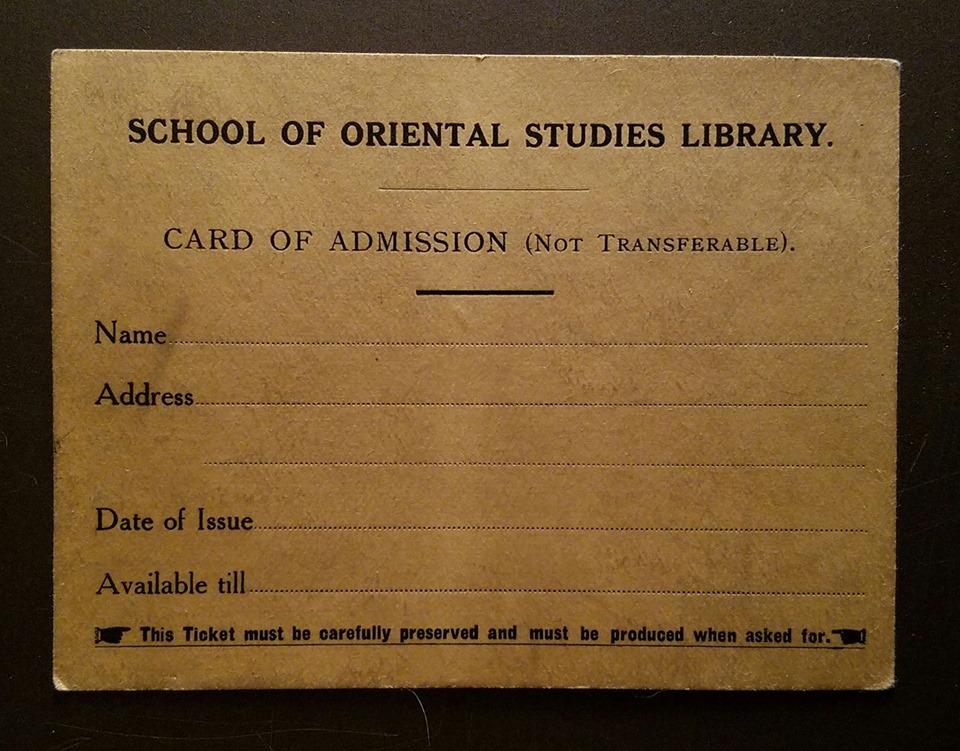
Post-1945 Card of Admission, School of Oriental Studies Library

School of Oriental Studies Library, Post-1945 Card of Admission (front)
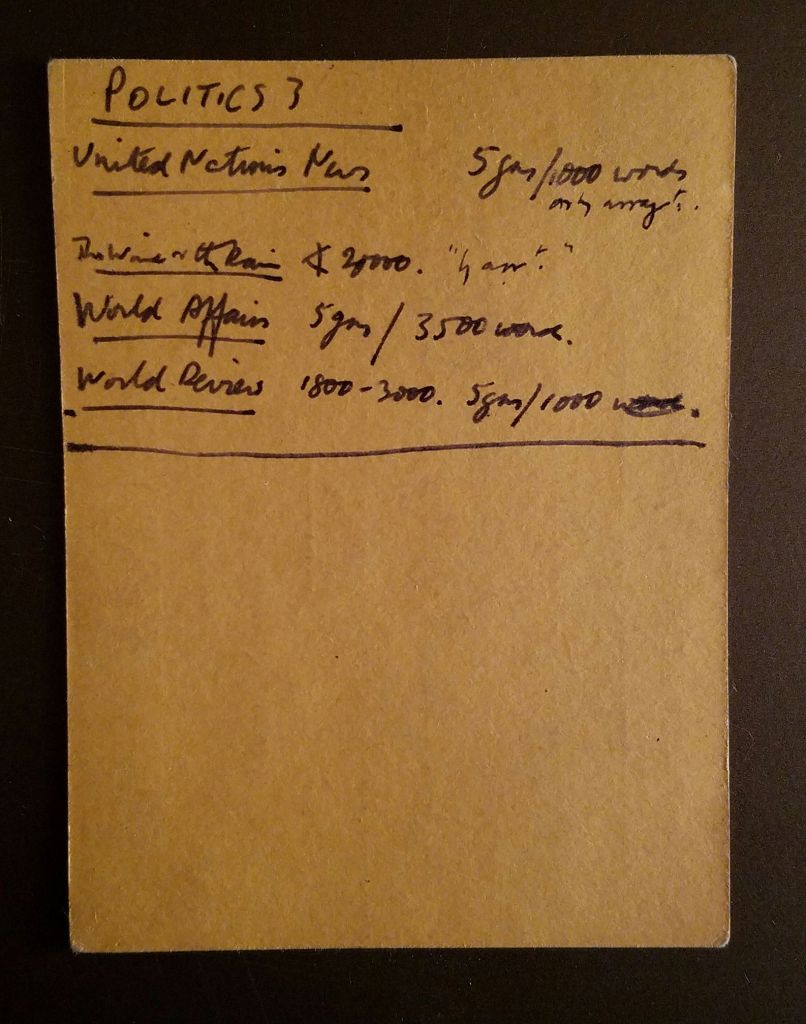
School of Oriental Studies Library, Post-1945 Card of Admission (back)

The School of Oriental Studies

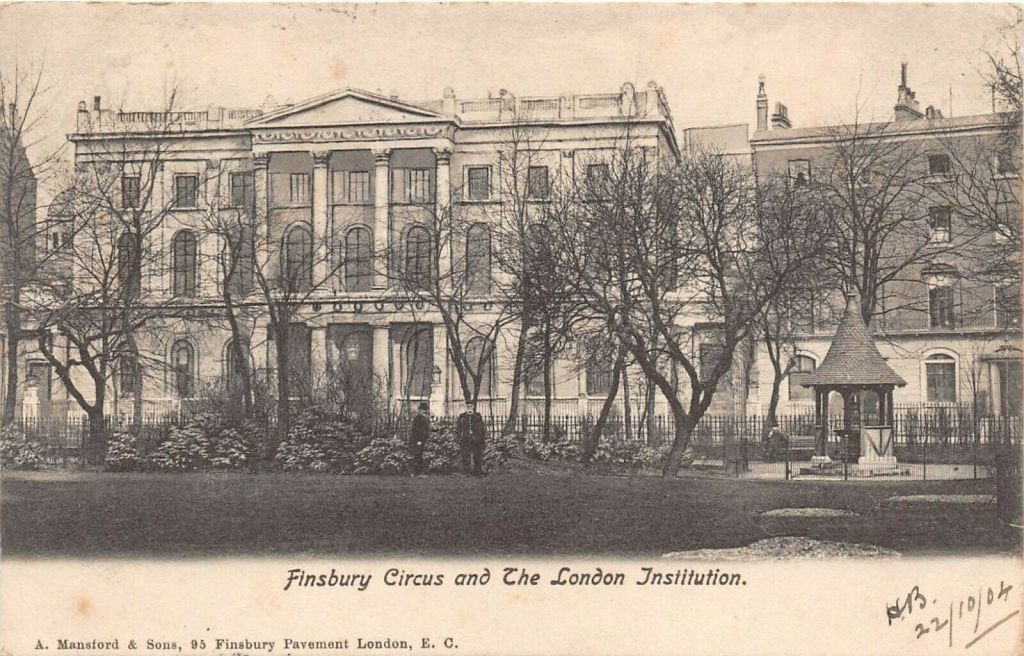
Opened in 1916, The School of Oriental Studies, part of the University of London in London, England, was originally housed in the former London Institution buildings at Finsbury Circus.  In the mid-1930s, the School of Oriental Studies moved to Bloomsbury and subsequently, the buildings of the London Institution were abandoned and then demolished.

Finsbury Circus and The London Institute (Public Domain Pre-1923 Postcard)

Focusing on Asian, African and Middle Eastern studies, the library holds over one million volumes and electronic resources for the study of Africa, Asia and the Middle East, and was designated by HEFCE in 2011 as one of the United Kingdom’s five National Research Libraries.   Since 1973, the library has been located in the Philips Building on the Russell Square  campus of the University of London.  The Philips Building was designed by British architect Sir Denys Lasdun, who also designed some of Britain’s most famous brutalist buildings such as the National Theatre and the Institute of Education.   

Columbia University Libraries, New York

Temporary Columbia University Libraries Identification Card for Reference and Stack Privileges issued to Elenor M. Alexander on July 13, 1942 for one week expiring July 20, 1942

1940s Columbia University Libraries Card (front)
1940s Columbia University Libraries Card (back)

Columbia University Libraries

Columbia University’s Low Library (Public Domain – pre-1923 postcard)

The Library of Columbia University, also known as the Low Library, served as the main library from 1890s to the 1930s.  By the 1930s, the Low Library had over a million volumes and space because an issue, but with a .4 million dollar donation from the Standard Oil Company, the new Butler Library, with space for over 2 million volumes, was constructed and opened in 1934.  Today, the Columbia University Libraries hold more than 5 million volumes, as well as 2.5 million microform unites and 22 million manuscript items.  The Columbia University Library system collection would stretch nearly 174 miles.  It is the fifth largest academic library in the United States and the largest academic library in the State of New York.  The Low Library now serves as the university’s administrative center.

The libraries currently in the Columbia University Library System are:

• Avery Architectural and Fine Arts Library

• Barnard College Library

• Burke Library at the Union Theological Seminary 

• Business & Economics Library (Watson) at the Columbia Business School 

• Butler Library

• Center for Human Rights Documentation and Research

• Columbia Center for Oral History

• Columbia University Archives

• Digital Humanities Center

• Digital Science Center

• Digital Social Science Center

• East Asian Library (Starr)

• Engineering Library (Monell)

• Geology Library

• Geoscience Library at the Lamont-Doherty Earth Observatory in Pallisades, NY 

• Global Studies

• Health Sciences Library at the Columbia University Medical Center in Washington Heights in Manhattan

• Jewish Theological Seminary

• Journalism Library

• Arthur W. Diamond Law Library at the Columbia Law School  

• Lehman Social Sciences Library at the School of International School of International and Public Affairs  

• Mathematics Library

• Milstein Undergraduate Library of  Columbia College 

• Music & Arts Library (Weiner)

• Off-Site Shelving Facility (ReCAP)

• Rare Book & Manuscript Library

• Science & Engineering Library

• Journalism Library of Columbia Journalism School 

• Social Work Library of Columbia University School of Social Work

• The Gottesman Libraries of Teachers College

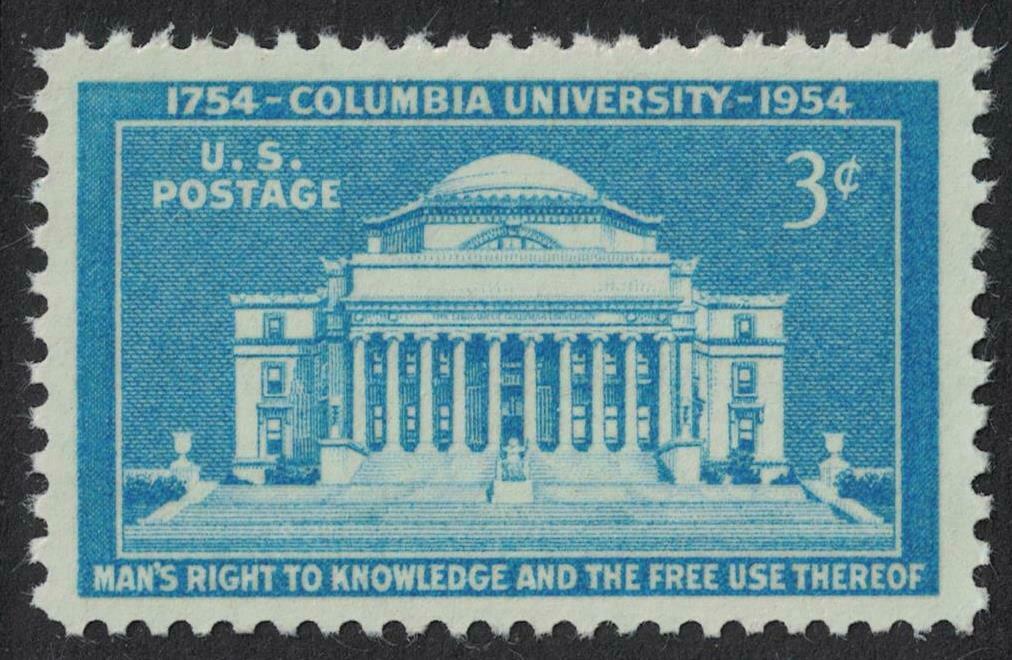
1954 commemorative 3 cent stamp celebrating the 200th anniversary of the Low Memorial Library

Dr. Charles Clarence Williamson

From the Library Journal April 1, 1920 (Public Domain)

C. C. Williamson (1877-1965) served as Director of the Columbia University Libraries and Dean of the Columbia School of Library Service from 1926 to 1940.  He began his career at the New York Public Library in 1911 using his background in economics to become the head of the  then new Division of Economics. His 1919 report for the Carnegie Corporation, The Williamson Report, criticized the educational requirements of librarians and believed a university graduate degree and not a college bachelor’s degree was the appropriate education for professional librarians.  In response to the Williamson Report, The Graduate Library School of the University of Chicago was founded in 1928 and provided librarians with a one year of postgraduate education in librarian science.  By the 1950s, most library schools offered master’s programs in library science.  In 1999, Williamson was named as one of 100 American librarians that made a lasting impact on library service.  

Elenor M. Alexander 

Elenor M. Alexander (Naughton) (1920-1995), born in Morristown, New Jersey, was the night supervisor at the Ocean County Observer for 10 years, and as a 40-plus year resident of Brick, New Jersey, served her community as a Girl Scout and Cub Scout leader.