Manchester Free Libraries, Campfield Lending Branch, Manchester, England

Borrower’s Card No. 9199 (2nd Series) issued to Henry Thomas Manners on May 16, 1865
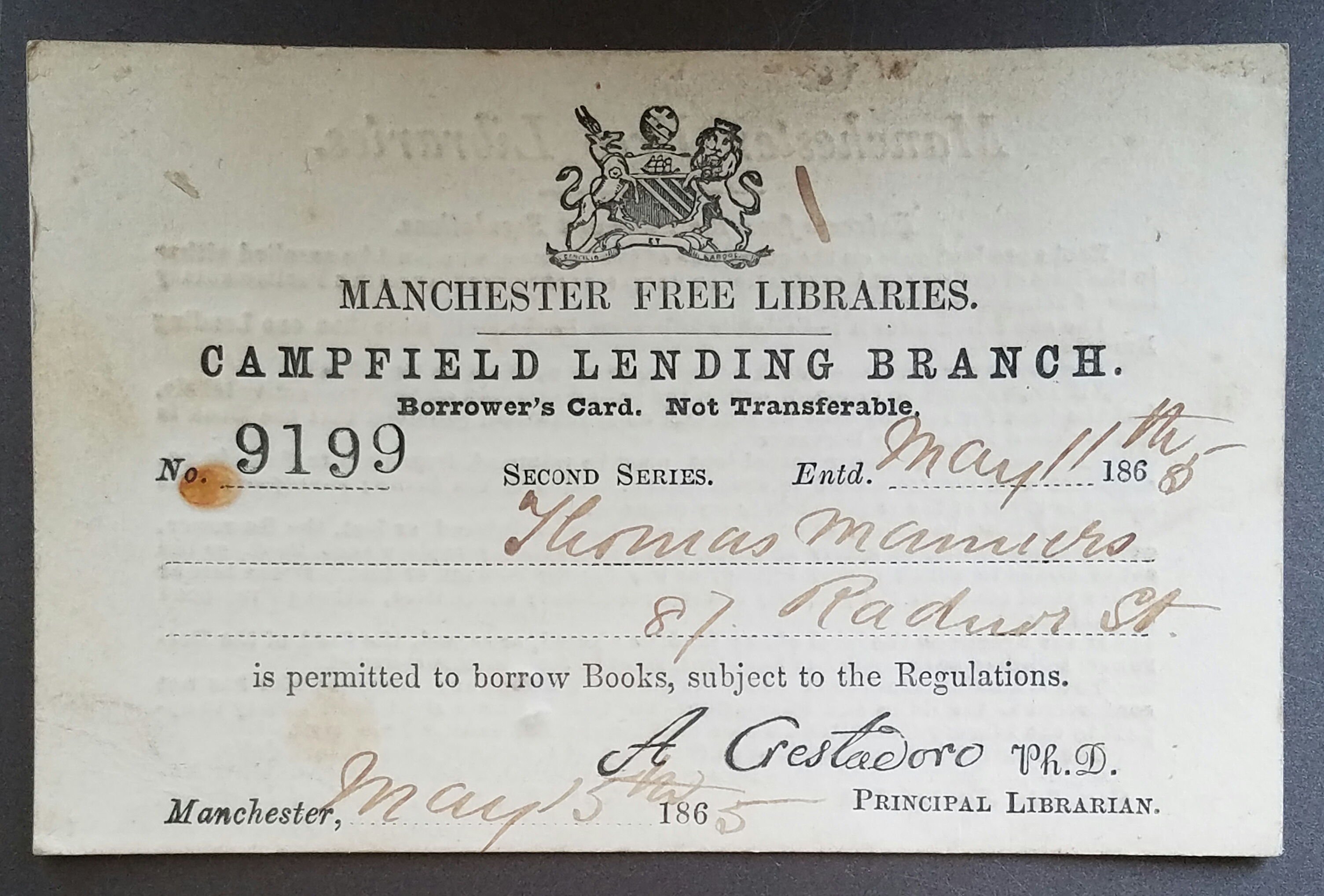
1865 Manchester Free Libraries Borrower’s Card (front)
1865 Manchester Free Libraries Borrower’s Card (back)

Manchester Free Libraries – Campfield Lending Branch

The Manchester Free Library at Campfield was the first lending library in England.   

Mirroring the Museums Act of 1845, which would “[empower] boroughs with a population of 10,000 or more to raise a ½d for the establishment of museums,” the Public Libraries Act (also known as the Free Library Act) was instituted in England.  While establishing the Act was not without argument, most notably the imposition of taxes, the voting body (the burgess-role) adopted the Act and became law with Royal Assent on August 14, 1850.

Soon after the Public Libraries Act was established, the Mayor of Manchester, John Potter (1815-1858), began a two-year effort to raise funds to house and stock the future library, and with the support of wealthy benefactors, the library finally opened with much fanfare on September 5, 1852.  Attendance at the opening ceremonies was over 1,000 persons, and included addresses from notable writers, Charles Dickens, William Makepeace Thackeray and Sir Edward Bulwark Lytton.

During the first weekend, nearly 10,000 people passed through the doors of the new library.

Etching by unknown artist of Manchester Free Libraries – Campfield Lending Branch, Manchester, England (Source:  “Manchester Public Free Libraries: a History and Description, and Guide to Their Contents and Use,” by William Robert, 1899) (Usage: no known copyright restrictions)

Edward Edwards (1809-1882) – First Librarian of the Manchester Free Libraries (1852-1857)

Edward Edwards was one of the three proponents of the  Public Library Act of 1850, and subsequently appointed the first librarian of the Manchester Public Library.  While being granted an £80 pension, his “passion for the spread of knowledge led to personal poverty.”  His books and papers being his only assets at his death, he died penniless at the age of 73.

Andrea Crestadoro (1808-1879) – Chief Librarian, Manchester Free Libraries (1864-1879)

Andrea Crestadoro was Chief Librarian of the Manchester Free Libraries from 1864 to 1879.  He is credited with the development and implementation of the Keyword in Context Indexing catalog system used at the Manchester Free Libraries.

Henry Thomas Manners (abt. 1819-1895)

Henry Thomas Manners was an English merchant for Fabric manufacturer, Ashton & Company of Manchester, England. 
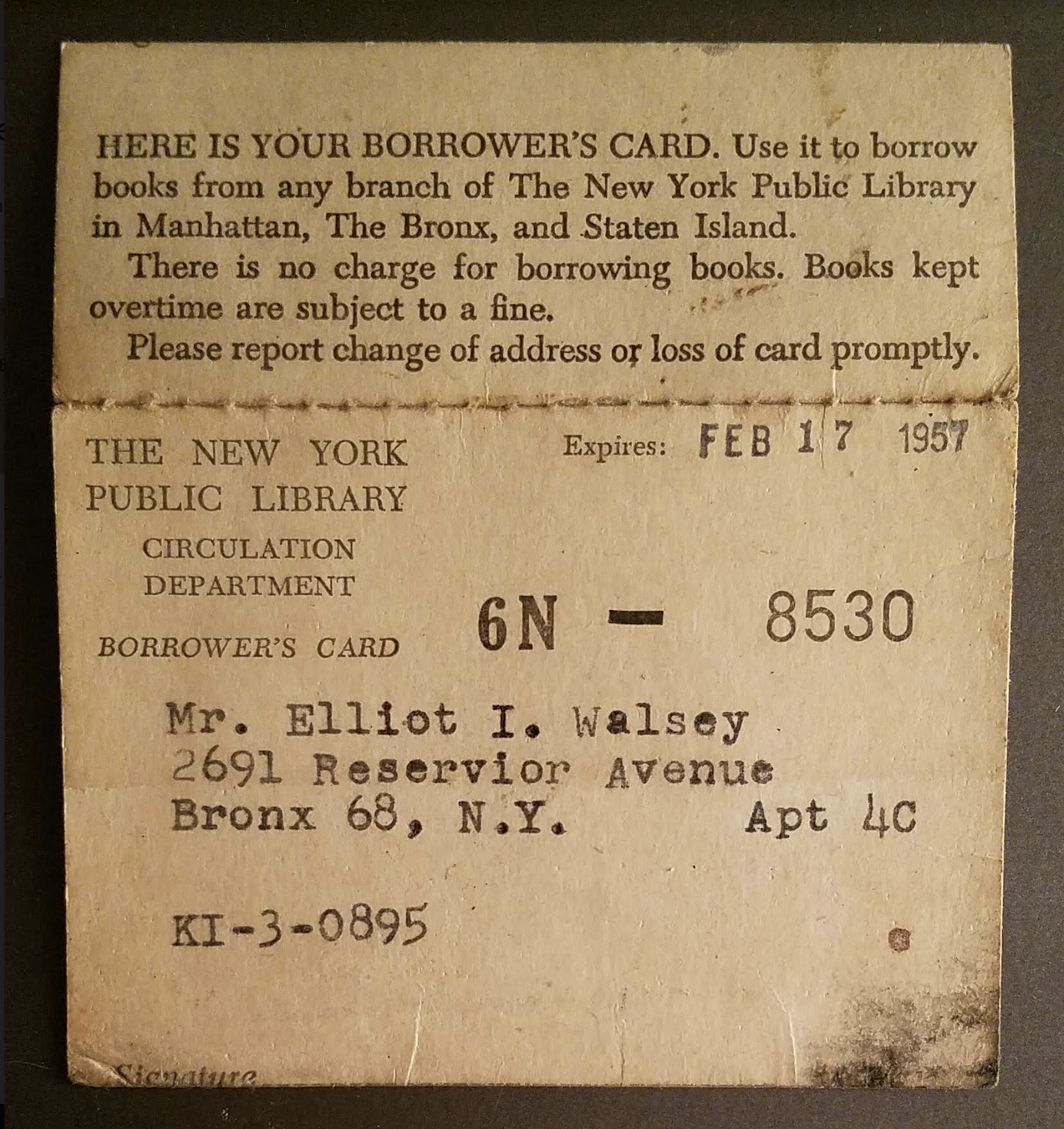
New York Public Library, Fordham Branch, Bronx, New York

1957 Borrower’s Card No. 6N-8530 Issued to Elliot I. Walsey

The New York Public Library (Bainbridge Avenue/Fordham Branch), Bronx, New York (Source: Wikimedia Commons/Julian A. Henderson) (Usage: https://creativecommons.org/licenses/by-sa/3.0/)(cropped)

The Fordham Branch Library building, designed by the prominent New York architectural firm McKim, Mead and White, who was known for designing the main New York Public Library in Manhattan, opened for circulation on September 24, 1923.  

“Realty Notes,” New York Times Newspaper, May 25, 1923

The New York Public Library, Fordham Branch, was one of many public libraries and public buildings endowed by steel magnate,  Andrew Carnegie.  In the latter years of his life, he believed the rich had a responsibility to “improve society,” and hence, donated $350M (equal to over $5B today) to the construction of over 3,000 libraries and public spaces in his birthplace, Scotland, the United States, and around the world.

Andrew Carnegie by Theodore C. Marceau (1913) (Source: Library of Congress)
(Usage: Public Domain)

The “Fordham Branch Library” having become too small to accommodate neighborhood needs, closed in November 2005 and reopened as the Bronx Library Center at 301 East Kingsbridge Road on January 17, 2006.  The new 78,000 square-foot facility is a state-of-the-art, green library that houses the New York Public Library’s premiere Latino and Puerto Rican Heritage Collection.

The Bronx Library Center (Kingsbridge Road), Bronx, New York
(Source: Wikimedia Commons/Julian A. Henderson)
(Usage: https://creativecommons.org/licenses/by-sa/3.0/)(cropped)

Elliot I. Walsey (1938-2012)

Elliot Ira Walsey, born September 26, 1938 in New York, New York, was an American business owner.  He was the founder and former President of Benchmark Graphics, Ltd.  

The Public Library, Washington, DC (Also Known as the Carnegie Library)

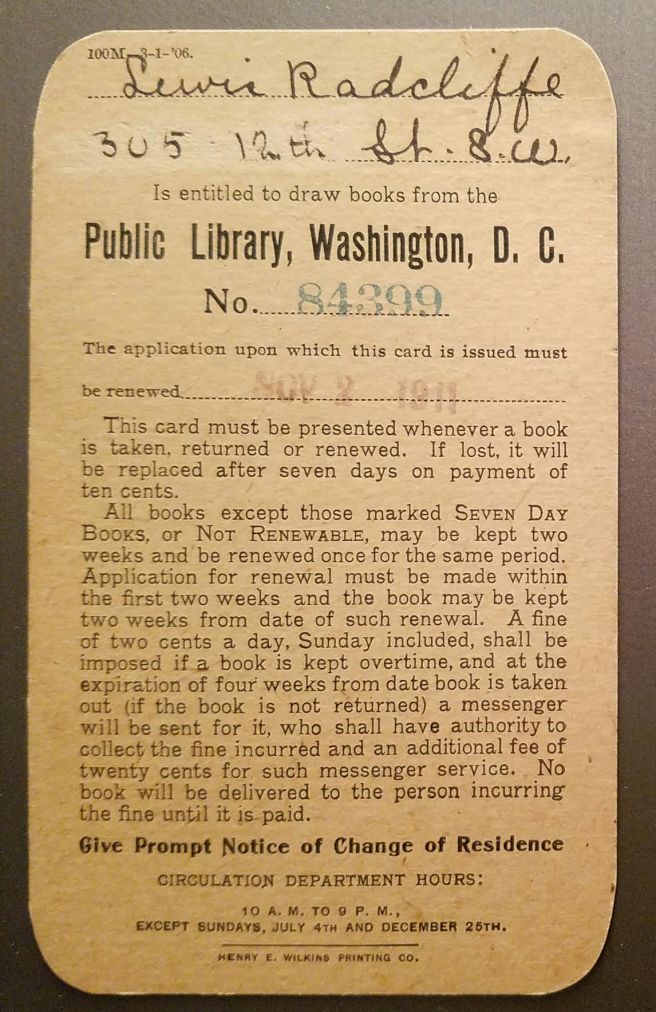
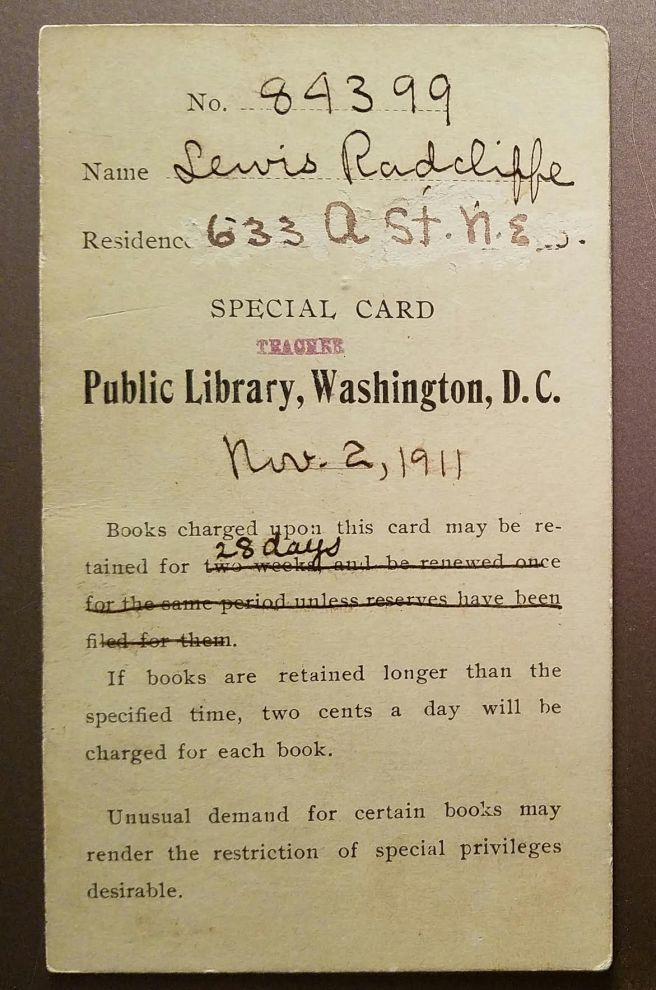
1908 Card No. 84399 and 1909 Special Card No. 84399 Issued to Lewis Radcliffe

Library Card for the Public Library, Washington, DC (back)
Special Card (teacher) for the Public Library, Washington, DC (front)
Special Card (teacher) for the Public Library, Washington, DC (back)
Special Card (teacher) for the Public Library, Washington, DC (inside)

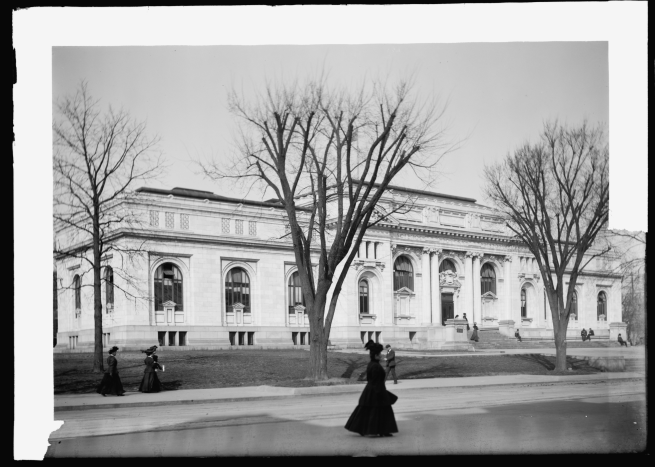
The Public Library, Washington, DC

The Public Library of Washington, DC, also known as The Carnegie Library or Central Public Library, is located in Mount Vernon Square at 8th and K Streets, NW. The Beaux-Arts building, designed by New York-based Ackerman & Ross, was dedicated by President Theodore Roosevelt and benefactor, Andrew Carnegie, on January 7, 1903.  The Carnegie Library was the first public library in Washington, DC, as well as the first desegregated public building in the Nation’s Capitol.

The Public Library, Washington, DC (also known as The Carnegie Library
(Source: Library of Congress – Usage: Public Domain)

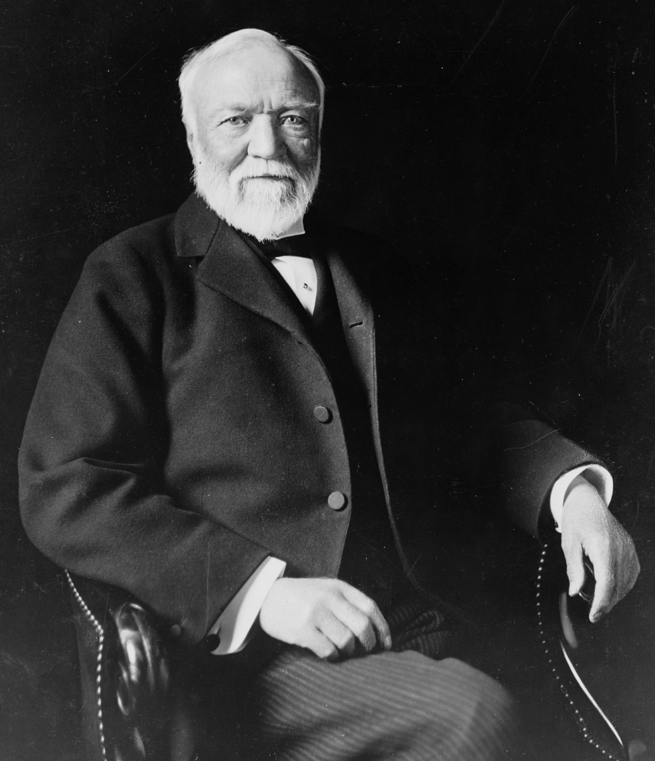
The Public Library of Washington, DC was one of many public libraries and public buildings endowed by steel magnate,  Andrew Carnegie.  In the latter years of his life, he believed the rich had a responsibility to “improve society,” and hence, donated $350M (equal to over $5B today) to the construction of over 3,000 libraries and public spaces in his birthplace, Scotland, the United States, and around the world.

Andrew Carnegie – Photo by Theodore C. Marceau (1913)
(Source: Library of Congress Usage: Public Domain)

The “Central Public Library” was added to the National Register of Historic Places in 1969.  In use for over 70 years as the main public library in Washington, DC, the Carnegie Library, after undergoing a $30M historic renovation, is currently the cite of the Apple Carnegie Library,  a multi-discipline learning center, which houses the DC History Center, Kiplinger Research Library,  three galleries, a museum store and an Apple products showroom. 

Lewis Radcliffe (1880-1950)

Lewis Radcliffe (Source: Binghamton Press, October 28, 1927

Lewis Radcliffe, born January 2, 1880 in Savannah, New York was an American naturalist, malacologist, and ichthyologist.  Educated at Cornell University (B.A. 1905) and George Washington University (M.S. 1915),  Radcliffe served as Deputy Commissioner of the United States Bureau of Fisheries until 1932. He was also the director of the Oyster Institute of North America until his death in 1950.