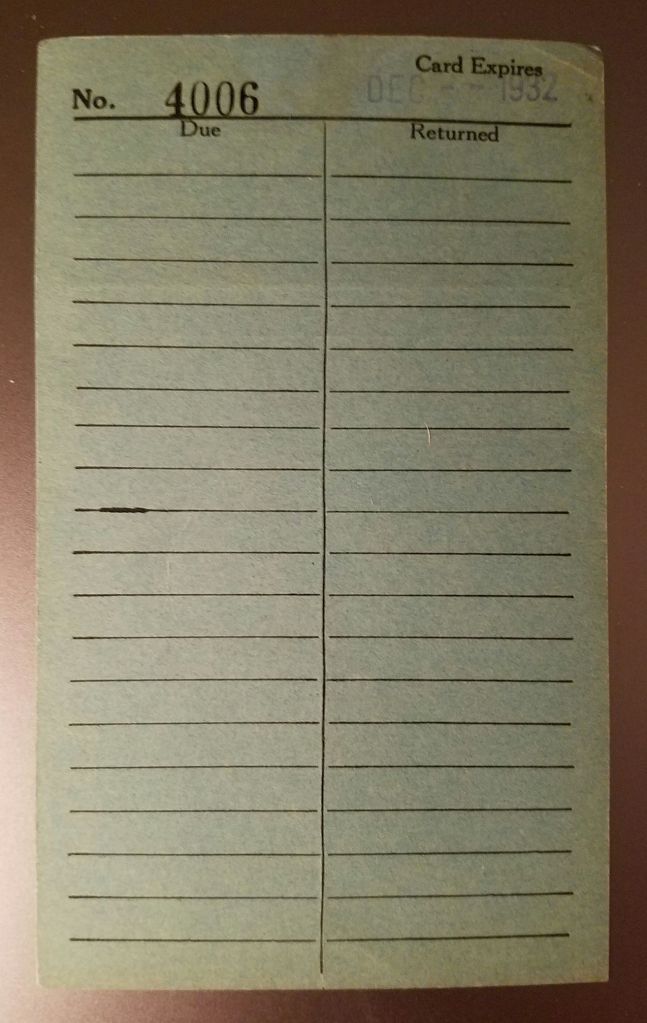
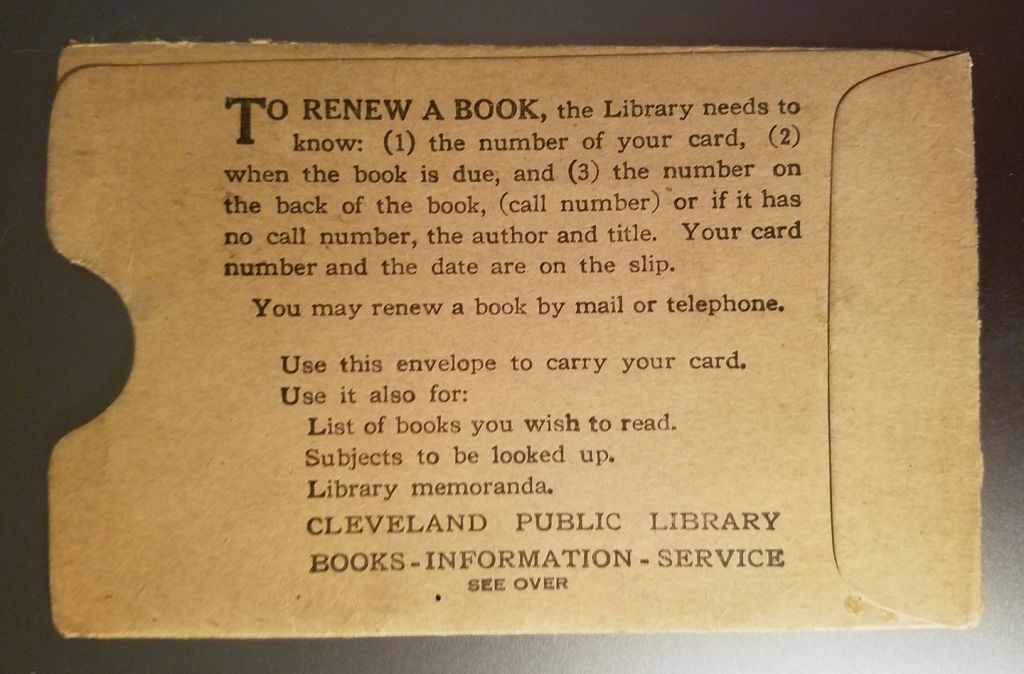
Cleveland Public Library, Pre-1932 Library Card No. 4006 and Card Sleeve issued to Walter R. Miller
Cleveland Public Library Pre-1932 Library Card (front)
Cleveland Public Library, Pre-1932 Library Card (back)
Cleveland Public Library Pre-1932 Card Sleeve (front)Cleveland Public Library, Pre-1932 Card Sleeve (back)
Cleveland Public Library
In March 1867, a legislative statute was passed authorizing the Board of Education to tax the citizens of Cleveland for the purpose of funding a public library. Housed on the third floor of the Northrup & Harrington Block on Superior Street, the library opened to the public on February 17, 1869, with approximately 2,000 books obtained from the public school library. By August 1869, there were nearly 4,000 registered members.
Northrup & Harrington Building, Superior Street, Pre-1923 Public Domain Postcard
Between 1873 and 1879, the Library moved multiple times. The Clark Building on Superior Street, the new City Hall, and the second and third floors of the old Central High School building on Euclid Avenue.
In 1884, the Cleveland Public Library appointed William H. Brett as Head Library. Brett, who was considered to be one of the most influential librarians of the twenty century, introduced the then-novel idea of an “open shelf” system, whereby library members would have direct access to the books. Brett served as Head Librarian until his untimely death in 1918.
William Howard Brett, Head Librarian of the Cleveland Public Library (1885-1911) (Public Domain)
In 1915, the Cleveland architectural firm, Walker and Weeks, won a competition to design a new library building, but due to the demands of World War I, construction was delayed until 1923. Finally, in September 1925, the $4,000,000 classical Renaissance-style building opened its doors to the public.
Cleveland Public Library, Superior Street, Pre-1923 Public Domain Postcard
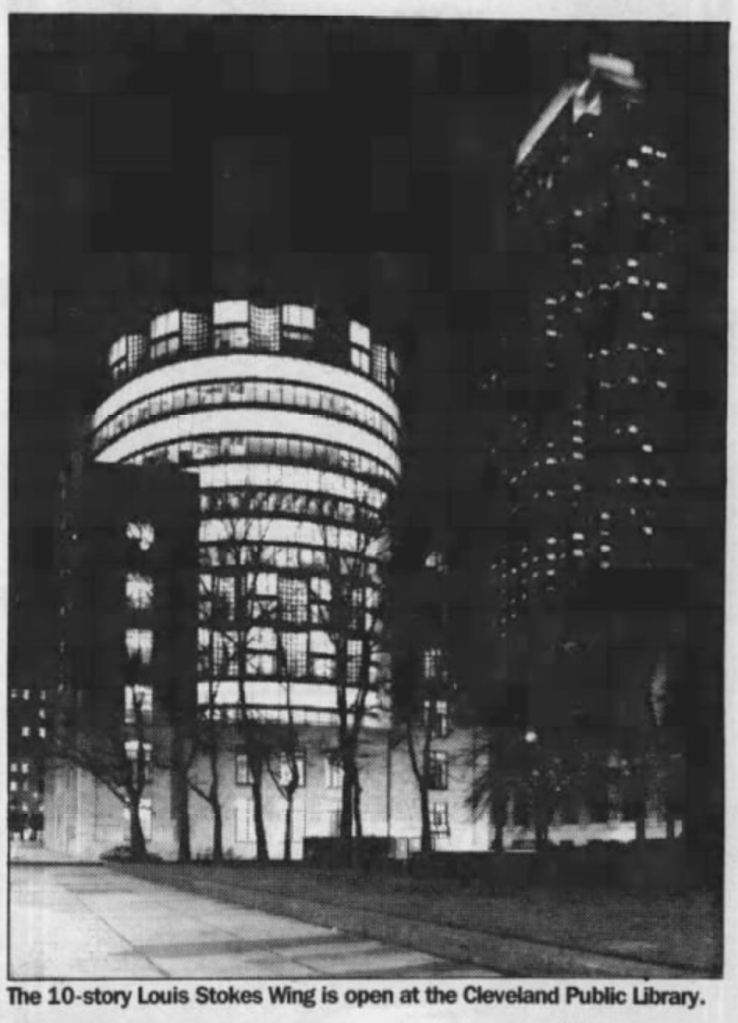
In 1997, the 10-story Louis Stokes Wing was dedicated and the main building underwent a $24 million renovation, including careful restoration of the original ceiling finishes, original leather doors, exterior marble and historical light fixtures.
The Louis Stokes Wing of the Cleveland Public Library. The Akron Beacon Journal (Akron, Ohio) June 12,1997, Page 75.
The Cleveland Public Library celebrated its 150-year anniversary in 2019. Today, the Cleveland Public Library system has twenty-seven branch libraries.
William H. Brett
William Howard Brett (1846-1918) was head librarian for the Cleveland Public Library from 1884 to 1918. He is considered one of the “100 most important librarians of the 20th century”. Under Brett’s guidance, book circulation at the Cleveland Public Library went from 50,000 volumes in 1889 to over 3 million volumes in 1918, placing the library in the top three of the greatest libraries in the United States at that time.
Brett was known for introducing several new library management concepts that are still used today. While at the Cleveland Public Library, he instituted an “open shelf” concept whereby allowing library members to have direct access to library materials and the ability to browse and research independently. Another major contribution was “divisional arrangements.” Brett and his vice-librarian, Linda A. Eastman, divided the reference and circulating books into major categories and had dedicated staff handle each subject matter. Brett also championed separate children’s reading rooms believing that children deserved their own space.
Brett’s life and library career were cut short by a drunk driver in 1918.
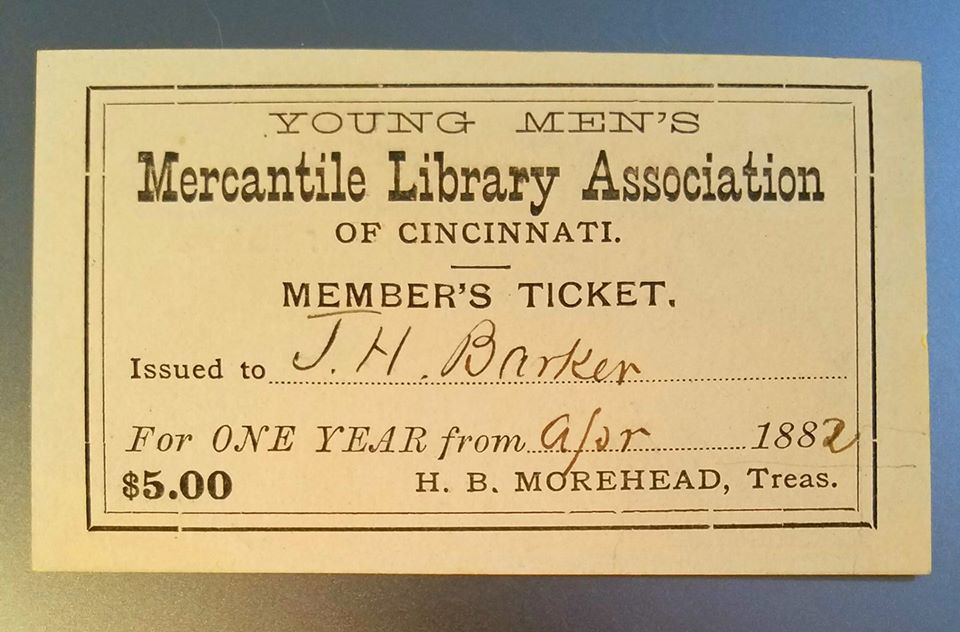
1882 Young Men’s Mercantile Library Association of Cincinnati Member’s Ticket (Circulation No. B. 69) Issued to J. H. Barker
1882 Young Men’s Mercantile Library Association of Cincinnati Member’s Ticket (Circulation No. B. 69) Issued to J. H. Barker (front)1882 Young Men’s Mercantile Library Association of Cincinnati Member’s Ticket (Circulation No. B. 69) Issued to J. H. Barker (back)
Young Men’s Mercantile Library Association of Cincinnati, Cincinnati, Ohio
The Young Men’s Mercantile Library Association of Cincinnati was established in April 1835 by Moses Ranney and 44 young men seeking to improve their skills within their mercantile trades. Lacking useful resources to improve their skills, they banded together to open a library that would cater to the needs of the undereducated and those seeking self-improvement. With seed money of $1800 and 700 volumes, the Library began operations in the Daniel Ames’ Building on Main Street, below Pearl, for $12.50 per month. Being a modest operation on a shoestring budget, there was no librarian, so all library duties were performed by the Directors. However, due to a steady increase in membership, the Library was able to elect their first librarian by the end of the first year. By 1836, the Library had approximately 1200 volumes.
The Library held art exhibits, literary readings and lectures by noted clergy, businessmen, and literary figures such as William Makepeace Thackeray, Ralph Waldo Emerson and Horace Greeley. The Library also encouraged the advancement of women by extending invitations to Harriet Beecher Stowe and Eliza Logan. Periodicals and worldwide newspapers, such as the London Times were available, as well as foreign language books. The Library also offered classes in languages, mathematics, book-keeping and penmanship.
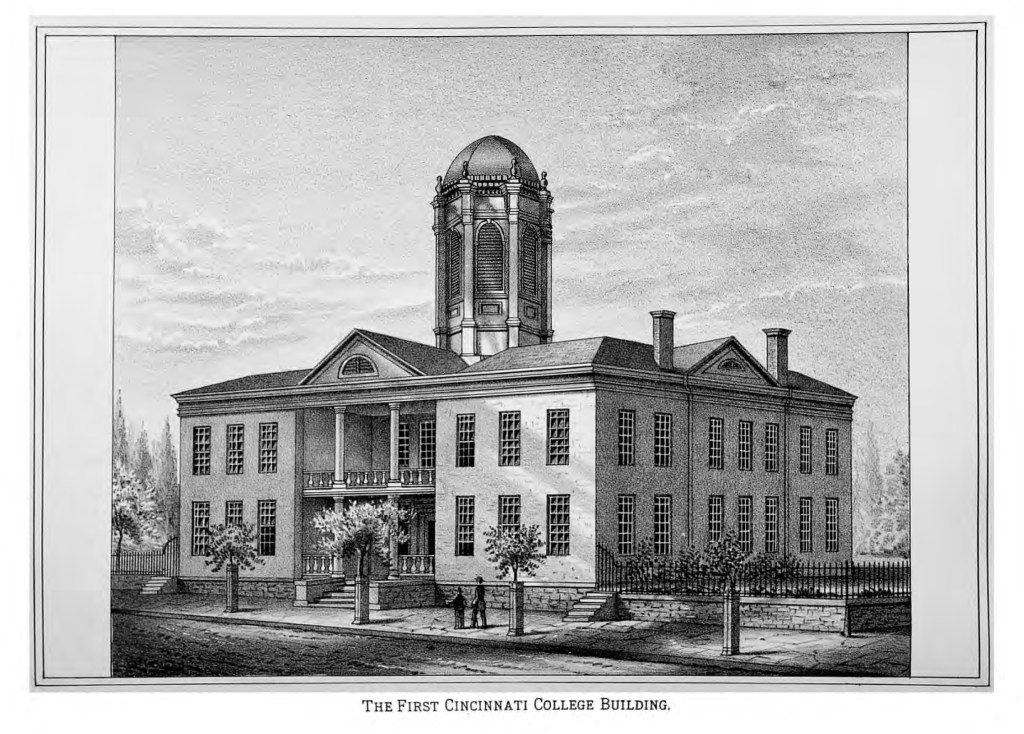
Early etching by unknown artist of the First Cincinnati College Building. (No known copyright restrictions. Used in accordance with Title 17 U.S.C. Section 107 and the Doctrine of Fair Use)
In Spring of 1840, the Library began its association with Cincinnati College and moved into rented rooms in the Cincinnati College building located on Walnut Street.
The Fire of 1845
On January 19, 1845, the Cincinnati College was destroyed by fire. Due to the heroic efforts of nearby members, many volumes were saved and transferred to rooms at the corner of Fourth and Sycamore Streets for temporary housing. This calamity offered the Library a unique opportunity. In consideration of the sum of $10,000 donated by the Library to go toward rebuilding, the Cincinnati College granted the Library ownership in perpetuity to a suite of rooms in the new building. Plans for a new 3-story building “exclusive of the attic” having “a modern edifice of Grecian Doric order” were announced in the Cincinnati Enquirer on March 3, 1846. The front area on the second floor would be designed for the accommodation of the Library.
Moving Forward
The Library remained active during this period of displacement. In 1853, a block of native marble taken from the Ohio River bedrock was donated to the construction of the Washington Monument.
Engraving on native marble block donated to the building of the Washington Monument in 1853 (public domain)
In addition to continued civic activities and cultural events, membership grew to 2,500 (by 1855) and the number of volumes available to members increased through purchase and donation to over 15,000. In 1859, women were permitted to join the Library.
The Fire of 1869
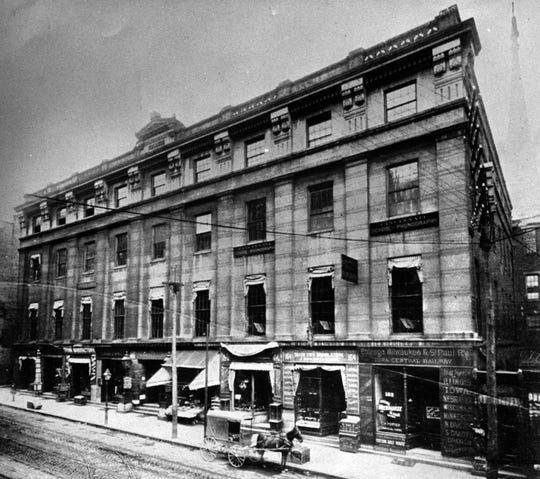
On October 20, 1869, a second fire destroyed the Cincinnati College building. Plans to build a new 4-story building were put into place by late 1869, and the Library temporarily moved to the A. E. Chamberlain & Co. building at 137-139 Race Street (between 3rd and 4th Streets). By 1871, the new 4-story building was opened and the Library was back on Walnut Street.
1890s photo by unknown photographer of Cincinnati College Bulidng on Walnut Street. (No known copyright restrictions. Used in accordance with Title 17 U.S.C. Section 107 and the Doctrine of Fair Use)
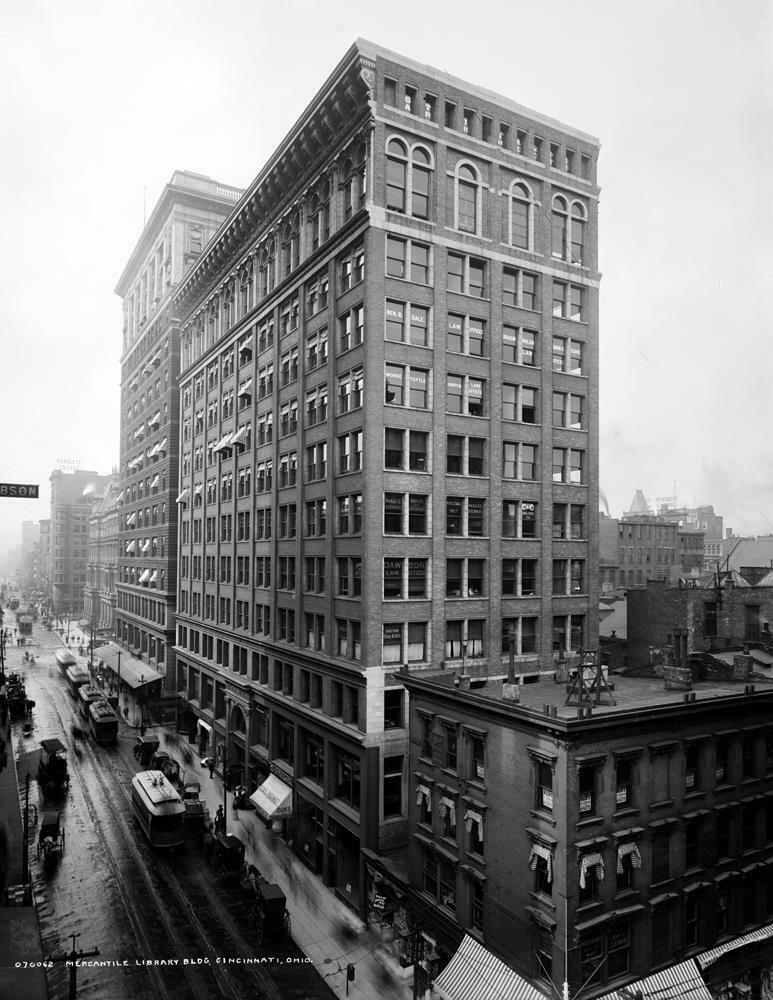
In the early 1900s, the Cincinnati College Building was sold to local business interests and a new 12-story building was built on the Walnut Street site. A 1905 city directory lists the Library address as 11th Floor Mercantile Library Building. The Library continues to operate from the Mercantile Library Building. It is one of the last subscription libraries in the United States.
Early 1900s photo by unknown photographer of Mercantile Library Building at 414 Walnut Street. (No known copyright restrictions. Used in accordance with Title 17 U.S.C. Section 107 and the Doctrine of Fair Use)
Moses Ranney
Moses Ranney (1810-1853) was a local business man and a leading figure in the organization of the Young Men’s Mercantile Library Association of Cincinnati. He served as the Library’s first President from 1835-1840. Born in Middletown, Connecticut to Moses Ranney, Sr. and Elizabeth Gilchrist, his father, Moses, died shortly after his birth. As a young man, he travelled to Cincinnati with his mother and established a business. In 1837, he married Catherine Maria Luckey (1818-1906), and together had six daughters, five of which pre-deceased Ranney.
A melodramatic article on the vices of drinking published in the February 1, 1855 Lancaster Gazette indicated Ranney’s life took a downward spiral and that he lost everything due to alcoholism. Perhaps a kernel of truth due to the trauma of loss of multiple children took its toll.
From the Lancaster Gazette, February 1, 1855
Moses Ranney died on August 20, 1852, in New Orleans, Louisiana of Yellow Fever. He was buried in the Cypress Grove Cemetery.
From the Times-Picayune (New Orleans, Louisiana), August 22, 1852
From the Richmond Weekly Palladium (Richmond, Indiana), September 23, 1853
H. B. Morehead
Harry “Henry” Blackburn Morehead (1847-1899), son of Kentucky Governor James T. Morehead, was a stockbroker and principal owner of H. B. Morehead & Co., a stocks and bonds brokerage. In 1891, being a majority stock holder, he assumed control and management of the Commercial Gazette Company. He succumbed to tuberculosis in 1899. He is buried in the Spring Grove Cemetery in Cincinnati, Ohio.
From The Courier-Journal (Louisville, Kentucky), March 28, 1899
J. H. Barker
Joseph H. Barker (1854-1902), son of Capt. Jonathan H. Barker (1814-1900), steamboat captain for the Cincinnati to Louisville Daily Packet Line, was a supervisor for the New Water Company. He succumbed to liver disease and is buried in the Spring Grove Cemetery in Cincinnati,
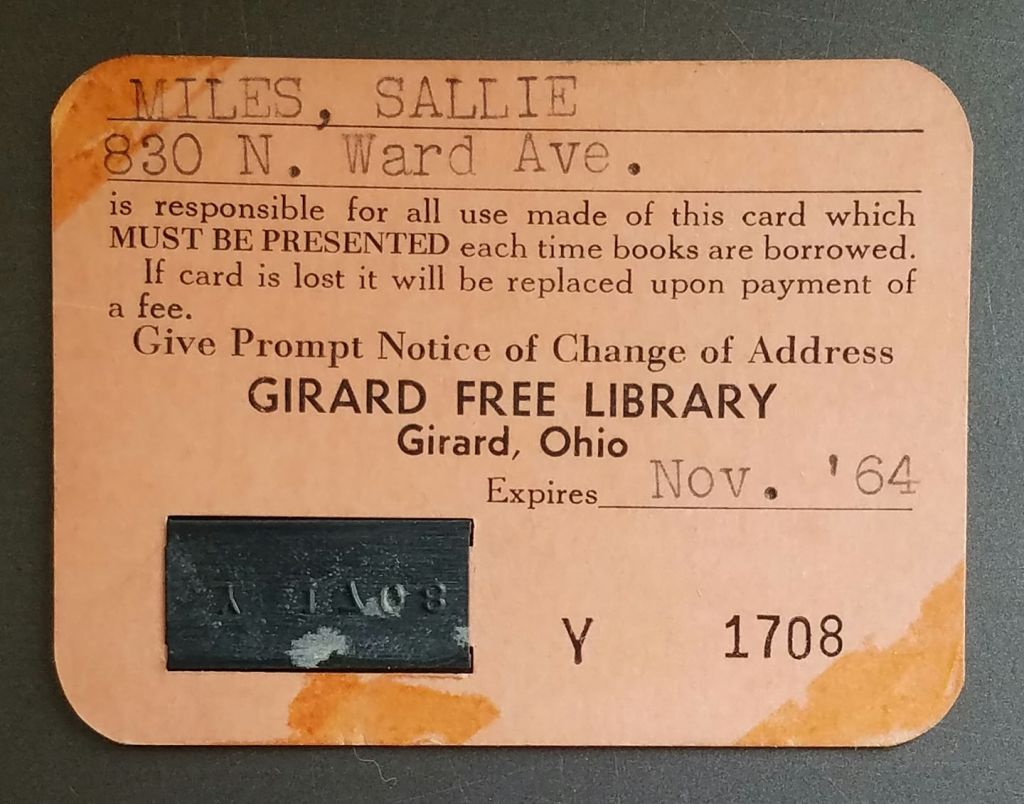
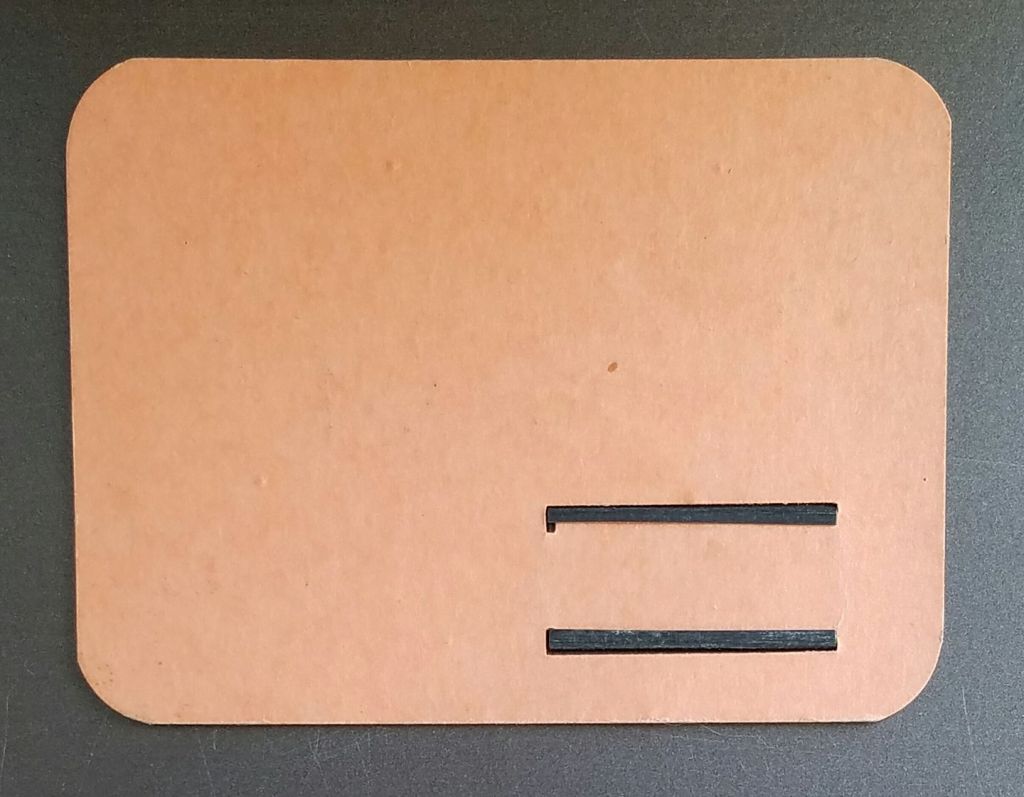
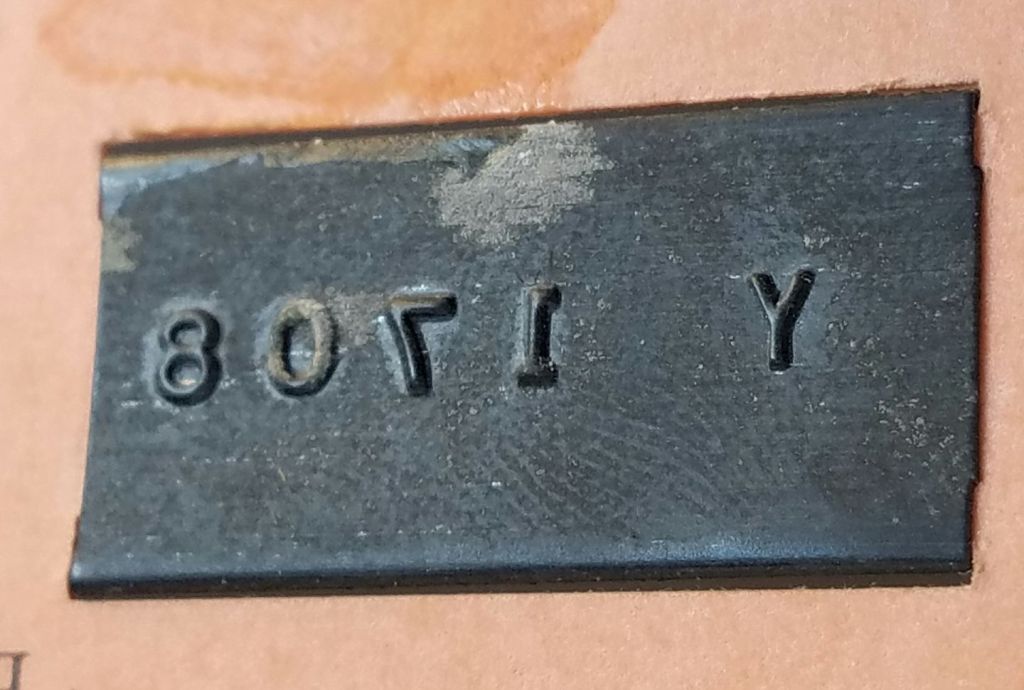
Girard Free Library, Library Card No. Y 1708 (member number type plate)
Girard Free Library
The Girard Free Library opened in 1921 and was housed in the 1861 Italianate-style building formerly called the Union School, Girard’s first school house. Prior to the opening of the library, the Union School was converted to the Village Hall, and subsequently, upon a large population surge and city incorporation, the Village Hall was converted to the City Building and became the home of the first public library in 1921. The Girard Public Library was located in the City Building until 1973 after which a new contemporary building was constructed on East Prospect Street, where the library can be found today.
Girard Town Hall (formerly the Union School) (pre 1923 postcard in the public domain)
Sallie Miles
Sallie I. Miles (1947-2011) was a 25+ year employee of RMI Titanium Co. in Niles, Ohio. She attended Capitol University in Columbus with an emphasis in music and later attended Youngstown State University’s Engineering Department.










 thelibrarycardmuseum.com