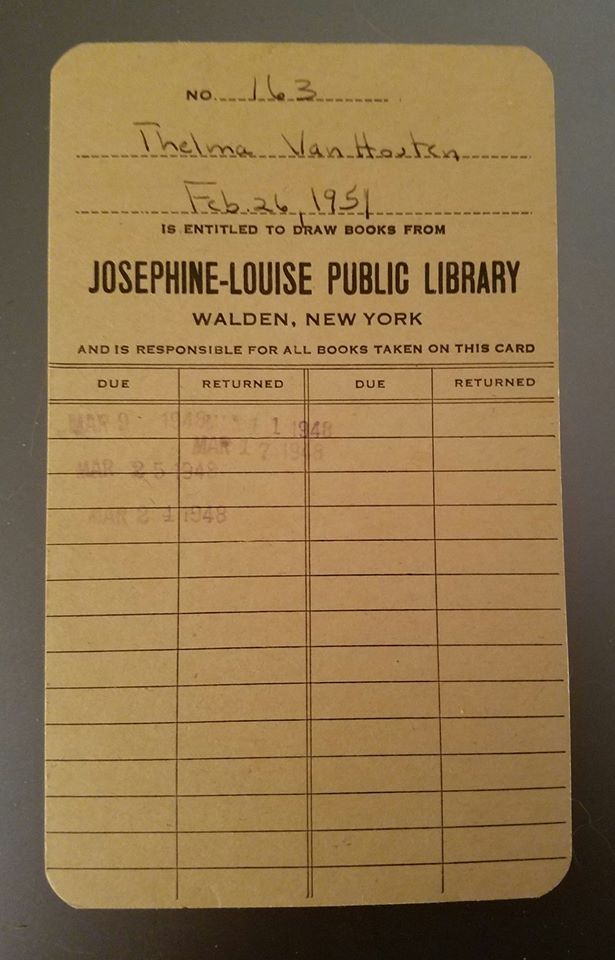
Pre-1951 Josephine-Louise Public Library Card No. 163 issued to Thelma Van Houten
Pre-1951 Josephine-Louise Public Library Card No. 163 issued to Thelma Van Houten (front)
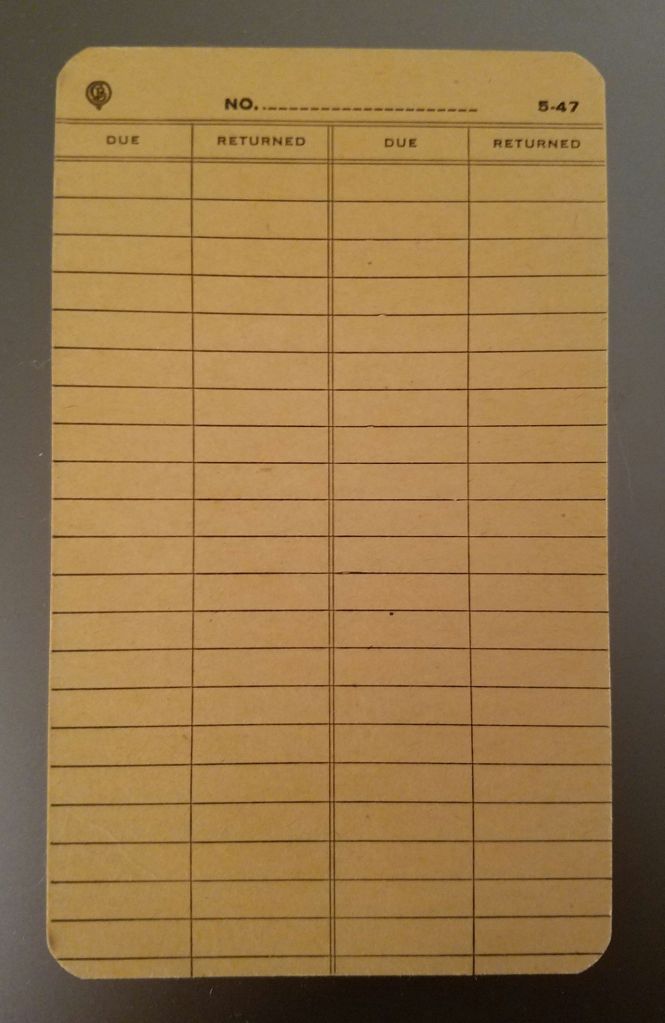
Pre-1951 Josephine-Louise Public Library Card No. 163 issued to Thelma Van Houten (back)
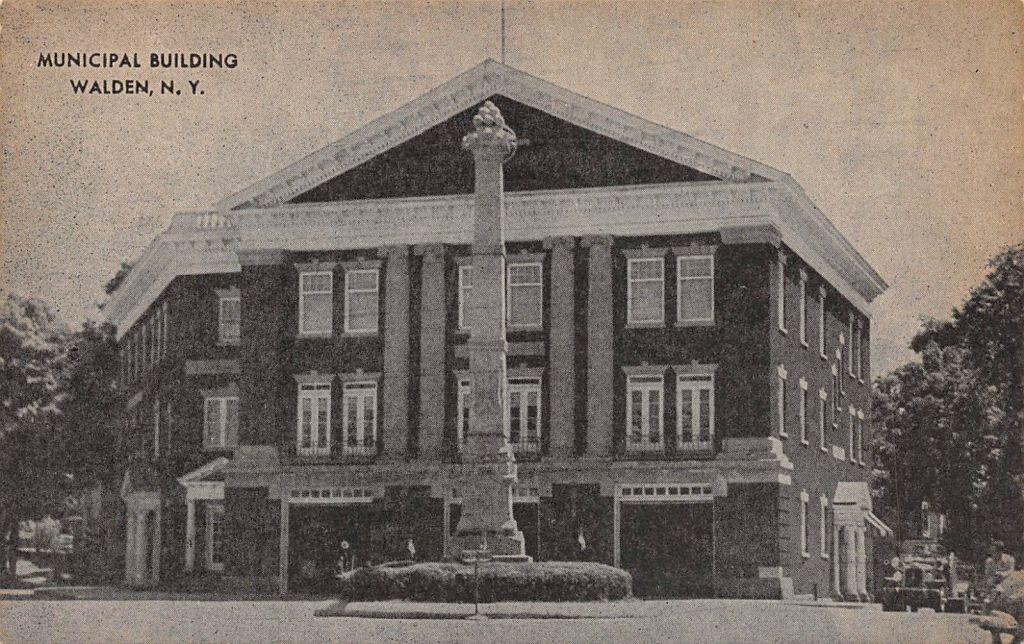
The Josephine-Louise Public Library, Walden, New York
The Josephine-Louise Public Library, Walden, New York (Pre-1923 Public Domain Postcard)
The Josephine-Louise Public Library is a memorial library dedicated to Josephine Dennison Bradley (1843-1903) and Louise Harper Bradley (1869-1900), wife and daughter of Col. Thomas Wilson Bradley (1844-1920), President of the New York Knife Factory, Medal of Honor recipient for his service during the Civil War, and a member of the US Congress.
The library began as a circulating library club in 1896 by a group of Walden residents that included Josephine Bradley. Upon petitioning the Board of Regents of the University of the State of New York, the circulating library was granted a 5-year provisional charter and, in 1901, the first Walden Public Library opened. In 1915, plans to build a new Municipal Building were put into place. Colonel Bradley, in honor of his wife and daughter, matched “dollar for dollar” the town budget to build the new facility which included a firehouse, as well as offices, an assembly room and, of course, a library space. In addition, he fully funded a temporary location in the village hall until the new Municipal Building was completed. The new Walden Municipal Building and Library opened at 5 Scofield Street in Walden in 1916.
Thelma Van Houten
Thelma Louise Van Houten (1/30/1929 – 6/19/1992), life-long New York native.
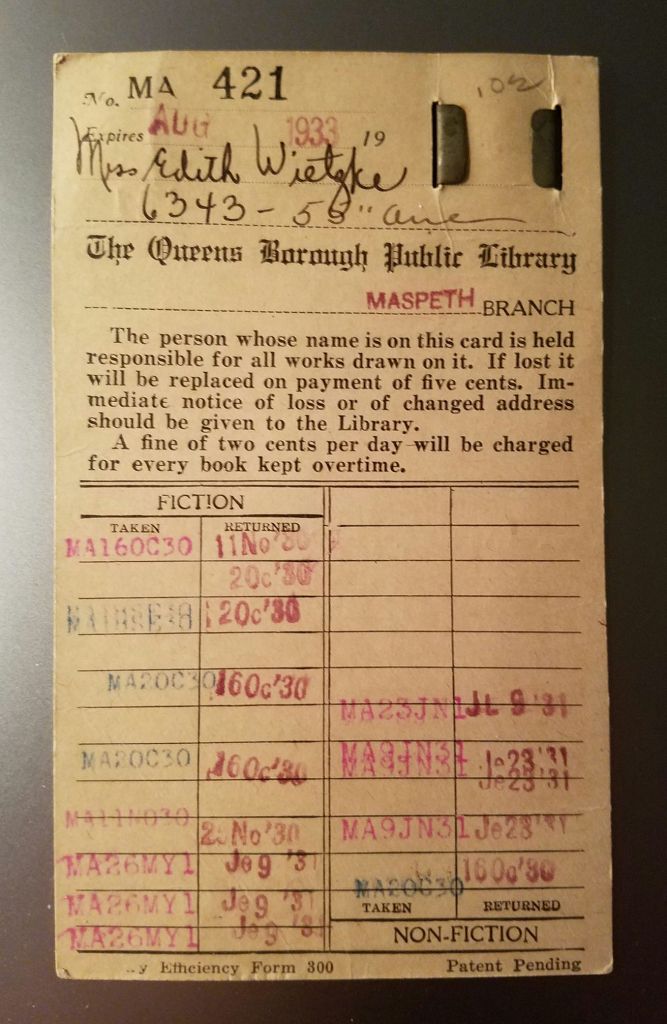
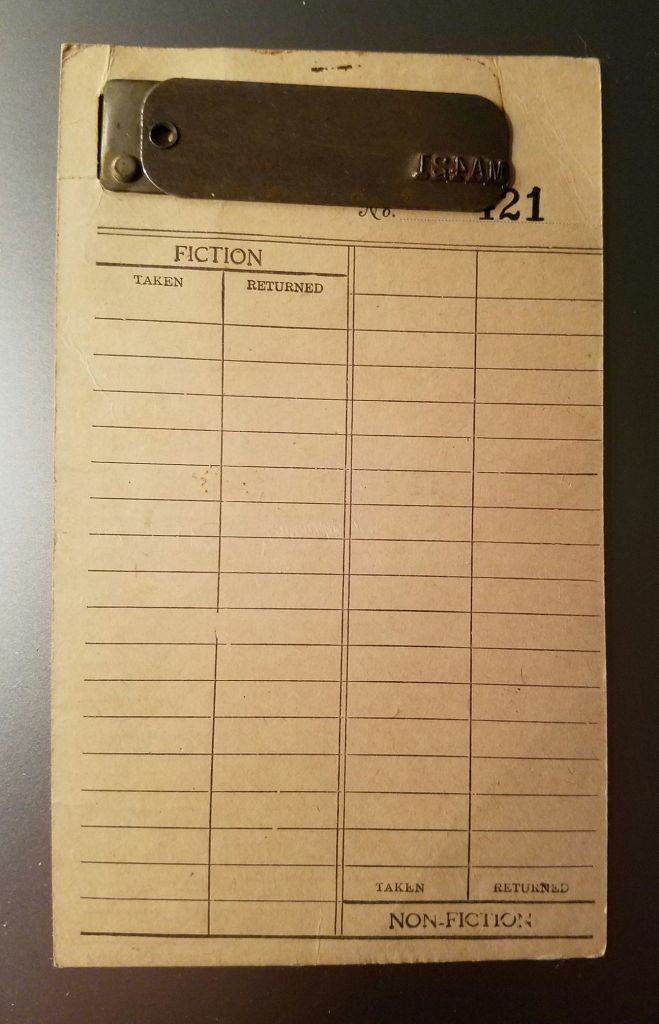
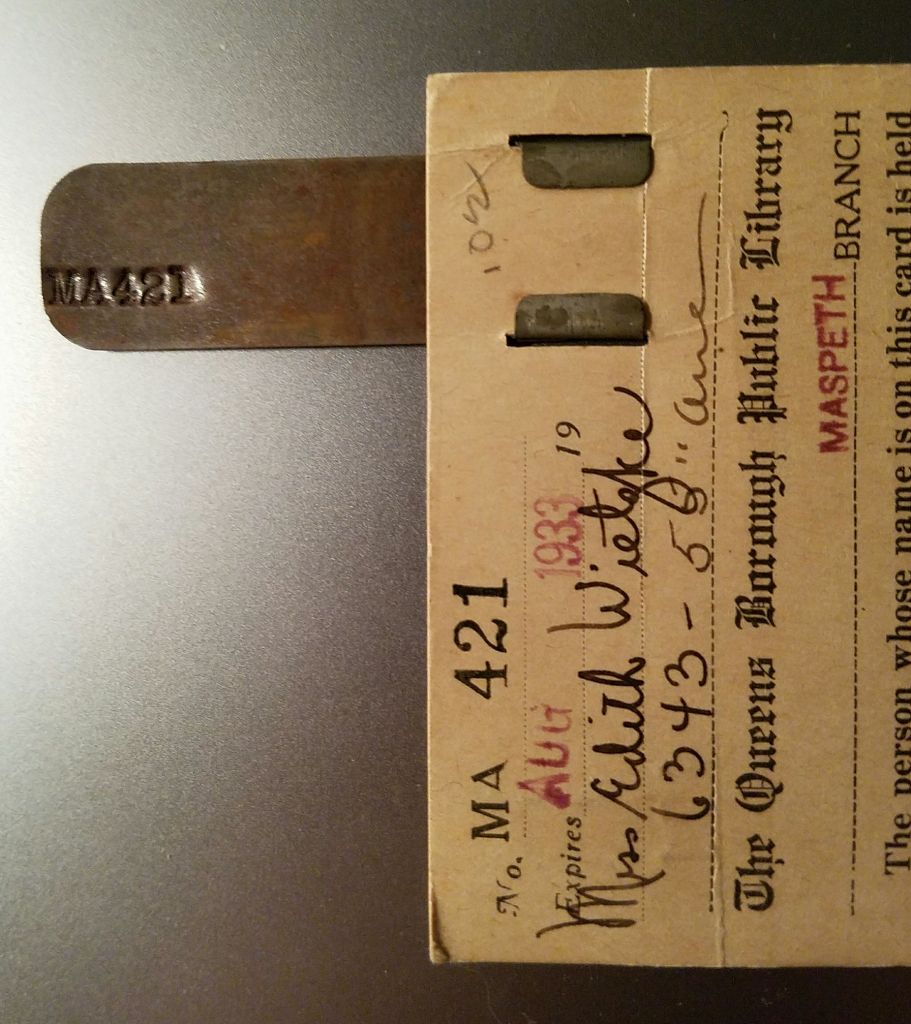
Pre-1930 The Queens Borough Public Library, Maspeth Branch Library Card No. MA 421 issued to Edith Wietzke
The Queens Borough Public Library, Maspeth Branch, Library Card No. MA 421 (front and back)
“Reference Card” with Swivel Number Plate by Joseph Dickman and George Lehman for Library Efficiency Corporation. U.S. Patent No. 1,875,955 issued September 6, 1932.
The Queens Borough Public Library, Maspeth Branch, Queens, New York
In the Report of the Queens Borough Public Library (1906), it was noted that there were large communities in the Queens Borough without library facilities. Maspeth, with a population of 3,800, was among those communities named. With this in mind, the Queens Borough Public Library opened a “traveling library station” at 80 Grand Street in Maspeth on July 27, 1911. Traveling libraries were often housed in drug stores, recreation centers, or other public spaces and tended to by proprietors that were willing to look after the distribution of books. In addition, dedicated “library stations” were housed in rented rooms and open to borrowers three times a week. Trained librarians that travelled to the stations maintained the distribution of the books and would oversee a monthly rotation of the stock to provide readers with an always up-to-date selection.
By July 1929, due to overwhelming use of the Maspeth library station, additional days and evening hours were added to the schedule giving borrowers additional time to use the library station facilities.
Over the years, the Maspeth Branch library station was housed in multiple locations, including 80 Grand Street, Grand Street and Columbia Place, the Legion Building at 47 Grand Street (in 1923); 66-40 Grand Avenue (during the 1930s), and ultimately 69-70 Grand Avenue, when a new facility was built in 1973.
Maspeth Library in the News
The Brooklyn Daily Eagle, March 8, 1921. Clipping courtesy of Newspapers.com. No known copyright restrictions.
Edith Witzke
Edith Wietzke (1913-unknown) was born in Vohwinkle, Germany. In April of 1923, Edith and her mother, Meta (1888-1950), and father, Reinhold (1880-1977), left the turmoil in Germany for Rio de Janeiro, Brazil. Two years later, in May of 1925, Edith’s father set off for America, followed by Edith and her mother three months later. The family settled in Maspeth, New York.
Pre-1974 Roswell P. Flower Memorial Library Borrower’s Card
Pre-1974 Roswell P. Flower Memorial Library Borrower’s Card (front)
Pre-1974 Roswell P. Flower Memorial Library Borrower’s Card (back)
Roswell P. Flower Memorial Library
Roswell P. Flower Memorial Library (Photo from “An Illustrated Souvenir of the Roswell P. Flower Memorial Library,” Watertown, New York, July 11, 1903, Dedication Pamphlet)(Public Domain)
The Roswell P. Flower Memorial Library was funded by Mrs. Emma Flower Taylor in memory of her father and designed by Orchard, Lansing & Joralemon of Niagara Falls. The library was dedicated on November 10, 1904.
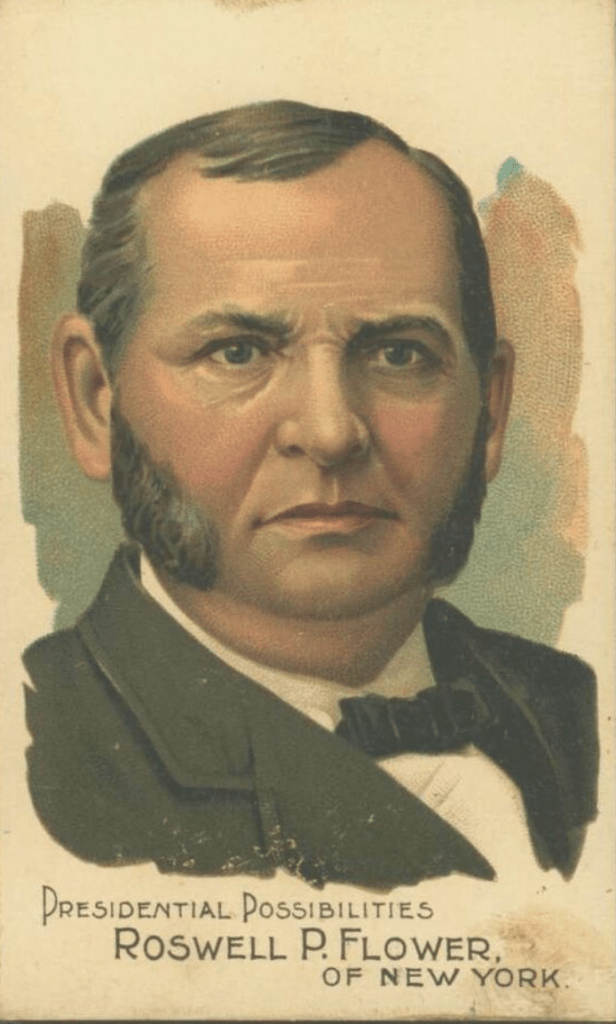
Roswell Pettibone Flower
Cigarette trade card from the “Presidential Possibilities” series, issued in 1888 by W. Duke Sons & Co. (public domain)
Roswell P. Flower (1835–1899), was a New York State Congressman from 1881 to 1890, and the 30th Governor of New York from 1891 to 1894.
Howard Ray Ferguson
Howard Ray Ferguson (1926–2001) was born in Watertown and worked for the Black-Clawson Co. in Watertown.
Temporary Columbia University Libraries Identification Card for Reference and Stack Privileges issued to Elenor M. Alexander on July 13, 1942 for one week expiring July 20, 1942
1940s Columbia University Libraries Card (front)
1940s Columbia University Libraries Card (back)
Columbia University Libraries
Columbia University’s Low Library (Public Domain – pre-1923 postcard)
The Library of Columbia University, also known as the Low Library, served as the main library from 1890s to the 1930s. By the 1930s, the Low Library had over a million volumes and space because an issue, but with a .4 million dollar donation from the Standard Oil Company, the new Butler Library, with space for over 2 million volumes, was constructed and opened in 1934. Today, the Columbia University Libraries hold more than 5 million volumes, as well as 2.5 million microform unites and 22 million manuscript items. The Columbia University Library system collection would stretch nearly 174 miles. It is the fifth largest academic library in the United States and the largest academic library in the State of New York. The Low Library now serves as the university’s administrative center.
The libraries currently in the Columbia University Library System are:
• Avery Architectural and Fine Arts Library
• Barnard College Library
• Burke Library at the Union Theological Seminary
• Business & Economics Library (Watson) at the Columbia Business School
• Butler Library
• Center for Human Rights Documentation and Research
• Columbia Center for Oral History
• Columbia University Archives
• Digital Humanities Center
• Digital Science Center
• Digital Social Science Center
• East Asian Library (Starr)
• Engineering Library (Monell)
• Geology Library
• Geoscience Library at the Lamont-Doherty Earth Observatory in Pallisades, NY
• Global Studies
• Health Sciences Library at the Columbia University Medical Center in Washington Heights in Manhattan
• Jewish Theological Seminary
• Journalism Library
• Arthur W. Diamond Law Library at the Columbia Law School
• Lehman Social Sciences Library at the School of International School of International and Public Affairs
• Mathematics Library
• Milstein Undergraduate Library of Columbia College
• Music & Arts Library (Weiner)
• Off-Site Shelving Facility (ReCAP)
• Rare Book & Manuscript Library
• Science & Engineering Library
• Journalism Library of Columbia Journalism School
• Social Work Library of Columbia University School of Social Work
• The Gottesman Libraries of Teachers College
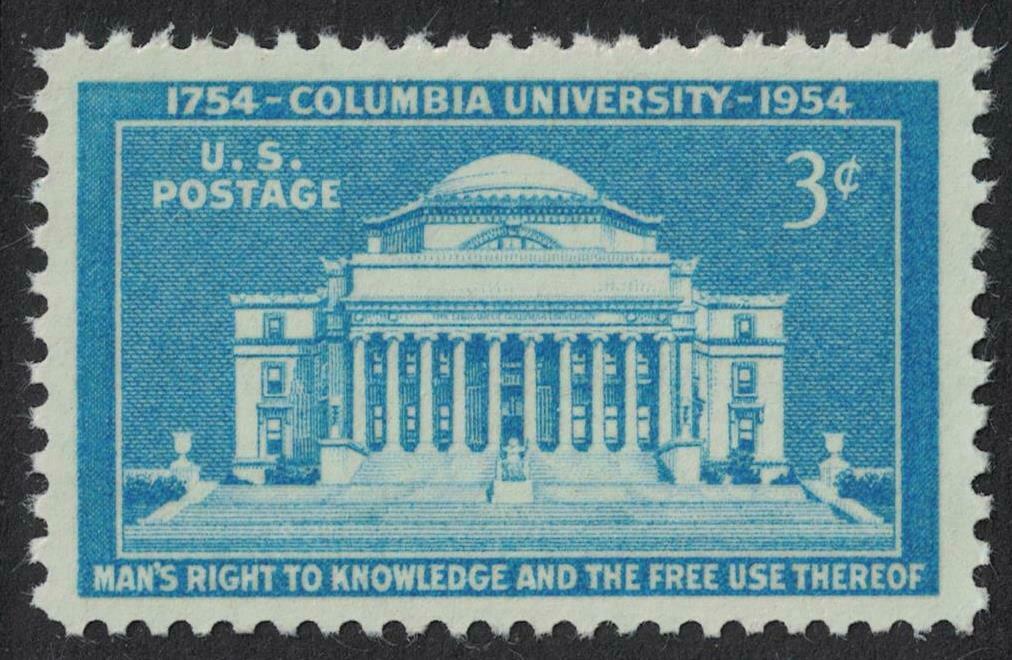
1954 commemorative 3 cent stamp celebrating the 200th anniversary of the Low Memorial Library
Dr. Charles Clarence Williamson
From the Library Journal April 1, 1920 (Public Domain)
C. C. Williamson (1877-1965) served as Director of the Columbia University Libraries and Dean of the Columbia School of Library Service from 1926 to 1940. He began his career at the New York Public Library in 1911 using his background in economics to become the head of the then new Division of Economics. His 1919 report for the Carnegie Corporation, The Williamson Report, criticized the educational requirements of librarians and believed a university graduate degree and not a college bachelor’s degree was the appropriate education for professional librarians. In response to the Williamson Report, The Graduate Library School of the University of Chicago was founded in 1928 and provided librarians with a one year of postgraduate education in librarian science. By the 1950s, most library schools offered master’s programs in library science. In 1999, Williamson was named as one of 100 American librarians that made a lasting impact on library service.
Elenor M. Alexander
Elenor M. Alexander (Naughton) (1920-1995), born in Morristown, New Jersey, was the night supervisor at the Ocean County Observer for 10 years, and as a 40-plus year resident of Brick, New Jersey, served her community as a Girl Scout and Cub Scout leader.
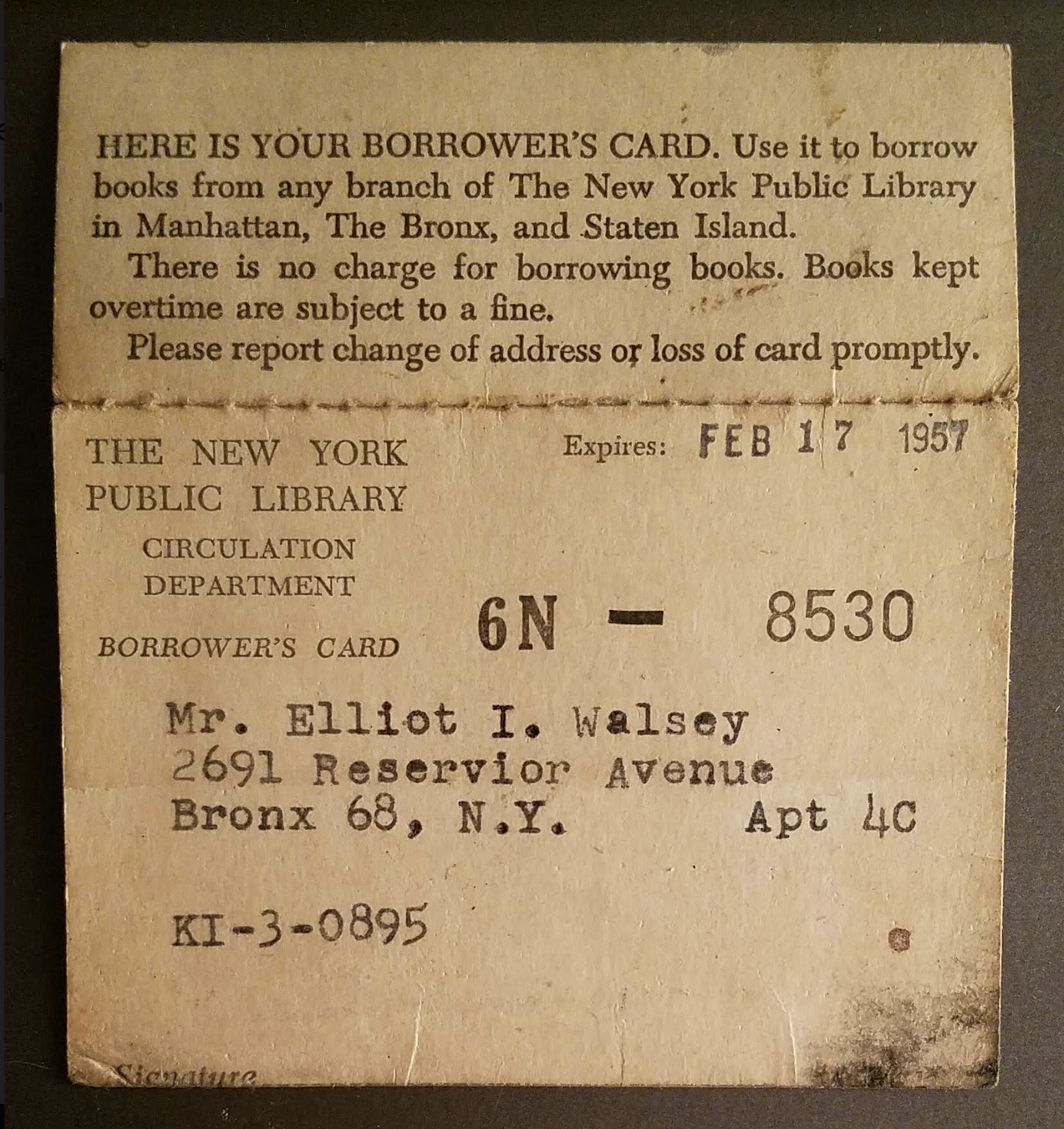
1957 Borrower’s Card No. 6N-8530 Issued to Elliot I. Walsey
New York Public Library, Circulation Department, 1957 Borrower’s Card No. 6N-8530 issued to Elliot I. Walsey
The New York Public Library (Bainbridge Avenue/Fordham Branch), Bronx, New York (Source: Wikimedia Commons/Julian A. Henderson) (Usage: https://creativecommons.org/licenses/by-sa/3.0/)(cropped)
The Fordham Branch Library building, designed by the prominent New York architectural firm McKim, Mead and White, who was known for designing the main New York Public Library in Manhattan, opened for circulation on September 24, 1923.
“Realty Notes,” New York Times Newspaper, May 25, 1923
The New York Public Library, Fordham Branch, was one of many public libraries and public buildings endowed by steel magnate, Andrew Carnegie. In the latter years of his life, he believed the rich had a responsibility to “improve society,” and hence, donated $350M (equal to over $5B today) to the construction of over 3,000 libraries and public spaces in his birthplace, Scotland, the United States, and around the world.
Andrew Carnegie by Theodore C. Marceau (1913) (Source: Library of Congress) (Usage: Public Domain)
The “Fordham Branch Library” having become too small to accommodate neighborhood needs, closed in November 2005 and reopened as the Bronx Library Center at 301 East Kingsbridge Road on January 17, 2006. The new 78,000 square-foot facility is a state-of-the-art, green library that houses the New York Public Library’s premiere Latino and Puerto Rican Heritage Collection.
Elliot Ira Walsey, born September 26, 1938 in New York, New York, was an American business owner. He was the founder and former President of Benchmark Graphics, Ltd.









 thelibrarycardmuseum.com